Ainá
1.641 words 8 min read
O ṣeun Ainá iya agba ti o ni asoju didun. O ni ibukun ori irawọ kan ti o fi ni l’agbara lati pada sọrọ. Awa ni eniyan yoo yọ pada sọrọ si esinmeta ti o wa ni alagbara lati fun wa ibukun ayaba yi. Awa ni eniyan yoo yọ pada sọrọ si iya esinmeta lati fun wa agbohun to dara ju. Awa ni yoo yọ pada sọrọ si esinmeta lati fun wa ni isonu ti o ni ọna ti o dara. Awa ni eniyan yoo ni ibukun ori irawọ kan ti o fi ni l’agbara lati pada sọrọ si Aina iya agba ti o ni asoju didun. Amin.
Who is Ainá?
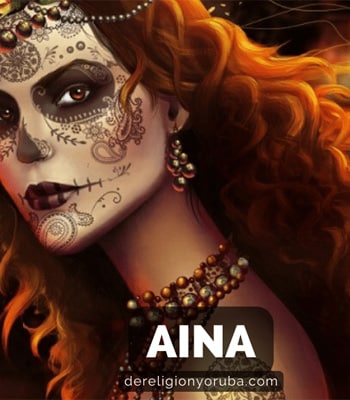
Her vessel is a clay pot that holds three bronze figures. Her necklace is red with jet beads, and an old rooster is attributed to her. According to Ifá, this orisha belongs to the family of the Ibeyis. She is born with the umbilical cord wrapped around her neck. She is the daughter of Ojo Shokuga and of Olofin. In Arará she is called Anabi; she is homely and lives wrapped in beads of every color. She is fed together with Changó. She lives in a clay pot with a hand of cowries and other secrets. This orisha is the sister of Anagui, who was the wife of Orula in the oddun Otura Meyi. She is a deity of the Muslim lands. She and Changó love each other dearly. As I understand it, AINA is an orisha who watches over children born with the umbilical cord around the neck. Ainá pays homage to birth. She is one of the seven Ibejí and dresses in red. She is associated with fire, and it is she who allows Shangó to breathe fire from his mouth when he speaks.
The word Ainá means flame — that is the context in which it appears — and she is the sixth of the twins. She is born of Oyá; remember that Oyá gave birth to nine sets of twins. Ainá is received to quell wars and troubles; her veneration was grounded in fire and in war. She also ensures that food, the sustenance of human beings, is never lacking. This orisha was born for the cults of worship, in the Ifá sign Ofun Abbe, or Efu eyeunle in the diloggún, which is where fire performs ebbó and becomes one of the principal elements for the development of the world; Aina comes to be the representative of flame on earth. Ainá is a female orisha, who should be represented by a small black doll dressed in red with a red necklace. Among her foundations she carries a
thunderstone and six spiral shells, and she lives in a red sopera (lidded tureen), mainly of clay. Some keep her in a wooden sopera. Etymologically, Ainá means, in one reading, «the one who came to save the world from the great wars».
Ainá’s sign of birth is eddibre, or oddi eyeunle in the diloggún, since that sign says that Ainá Yogún is born — the guiding spirit of the twins. For us it represents the umbilical cord with which human beings come to earth. When Oyá gave out all the twins, she handed Taiwon, Kaidde and Aina to Shangó so that he would see to their upbringing; for this reason she is said to be one of Shangó’s children.
She is one of those saints who have been making themselves known in the Americas only in recent times; even so, it is known that they do exist, because they have their sign of birth.
She is a saint received as addimú, essential for all iworos without exception, but especially for the children of Shangó. Her necklace is red with a rooster’s spur at the center. Her necklace may also be received by aleyos, should any of the signs mentioned above appear in a reading, to free them from wars or to resolve some problem.
It is believed that Aina’s birth had a significant impact in calming the wars and conflicts under way at the time of her arrival on earth. Because of this special intervention in situations of conflict, Aina becomes one of the most important orishas for practitioners of the Yoruba religion.
Ainá is regarded as a pure, transforming force in the Yoruba religion. Her power manifests in fire and is associated with the energy of transformation and renewal. As such, Aina is seen as a force capable of setting off radical changes in the lives of those who worship her.
Devotion to Ainá is a common practice in many rites and ceremonies of the Yoruba religion. Practitioners tend to worship her with devotion and respect, and it is believed she can grant wishes and blessings to those who honor her properly.
In short, Ainá is an orisha of great importance in the Yoruba religion. As the representative of transforming energy and the strength of the feminine, she becomes an invaluable companion for triumph in situations of war and conflict. Her power manifests in fire and is associated with the energy of transformation and renewal, which makes her one of the most venerated and respected orishas in the Yoruba religion.
What is Ainá like?
One of this woman’s notable qualities is her strong character. She is able to calm conflicts, but if her fury is unleashed she can be fearsome. Her transforming capacity is very high, allowing her to create or destroy in an instant. Yet she is also compassionate, thanks to a protective energy that defends life and survival from the moment of conception.
Ainá can be asked for help in ending wars and large-scale conflicts. She can also be invoked to protect pregnant women and to assist at the moment of childbirth. She is likewise asked for help when children fall ill, and for their protection in general. And she is asked to see that food is never missing from our table and to shield us through intense spiritual wars.
Number and color
The number 6 and its multiples are associated with Ainá because of the close bond this orisha shares with Shangó, her loyal ally. Aina’s distinctive color is red. Her necklaces, or elekes, are strung with beads of this color, and in some houses 3 to 4 black beads are added, evenly spaced, to divide the necklace.
Herbs
- Cagadiña de gallina.
- Hoja menuda.
- Hicaco (cocoplum).
- Pega pega.
- Mamoncillo.
- Manaju.
- Zapote.
- Rabo de gato.
- Tomato.
- Poplar (álamo).
A patakí of Ainá
Oggún and Oshosi both wanted to live with Ainá at any cost. The two went to consult Orunmila, who saw their Ifá sign and told them: «You must make a sacrifice with a hen, retama and ewefá.»
Oshosi replied at once: «I have no need of sacrifice to live with a woman, for I am the lord of the hunt and the savanna. I have an army of poisonous yams and thorn-covered bushes to protect me.» Oggún, for his part, followed Ifá’s advice and made the sacrifice, feeding Osanyin.
After that, Ainá went to live with Oshosi. One day, in great anger, she made fire spread through the whole forest, and the flames closed in mercilessly on Oshosi’s house. He cried out: «Ainá, my poisonous yams and my thorn-covered bushes have burned — stop it!» But she ignored him and went off to Oggún’s house.
The ceremony for receiving Ainá in Santería and Ifá
She is an orisha of addimú, meaning that her foundation is received but no itá is performed. During her consecration, only feathered animals are sacrificed. Her ceremony is very simple: the consecration is carried out and on the third day she is placed in the hands of the initiate.
In Ifá, on the other hand, this divinity is recognized as «Aina Yogun», which translates as the spiritual protector of the Ibejis and guardian of the odun Edibere. This orisha is embodied in a doll to which a rooster is sacrificed, and which is cleansed with the sacred herbs of the Ibeyis before being loaded.
How is she attended?
She is offered sweet wine or sangría, white candles, honey and corojo palm oil.
Offerings, or addimuses
The addimuses that may be offered to Ainá are varied, among them: sweets, eku (smoked jutía), eya (smoked fish), awado (toasted corn), mashed yam in sauce, black-bean tamales, red beans, black-eyed peas, black-eyed peas with annatto and black-eyed peas in the husk, cracked corn with fried pork, fried fish, bread and popcorn. She is also offered every kind of fruit.
ANIMALS
Roosters, pigeon, guinea hen and chicken are immolated to her.
Works, or ebboses, with Ainá
This ebbó is meant to draw love. First a lodestone is found, and the name and footprint of the person one wishes to bind are written on it; it is wrapped in amansa guapo herb and tied with red thread. Then a fire is lit in a tin with sticks of yamao, para mí and vira rumbo, and the orisha is told that the purpose of the ceremony is to sweeten and soften the feelings of the person one wishes to attract. The prepared lodestone is then cast into the fire. The ashes and the stone are kept in a red cloth envelope and placed inside the orisha’s sopera. Finally, when the beloved returns, a rooster is fed to her as a token of gratitude.
A work against enemies
When a work with Ainá is to be performed against our enemies, a clay plate is set out with 6 cotton wicks soaked in corojo palm oil, and they are set alight. The names of our enemies are then cast into the flame, and the orisha is told of the conflict we are facing, asking her to free us from it.