Changó
4.534 words 22 min read
Changó, the god of thunder and war
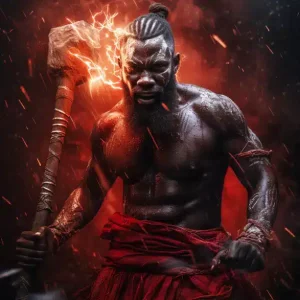
Changó, also known as Shangó or Alafi, is one of the most popular orishas in the Yoruba religion. Also called Shangó, Xango or Jakuta, he is the god of fire, thunder, the drums and justice. He is a warrior and a king, and he is considered the protector of the just and of those punished unfairly. In Cuban Santería, Changó is also syncretized with Saint Barbara, and his feast day is celebrated on December 4.
His name in Yoruba means war — troubles or solutions, everything for good and for ill. Within the Yoruba religion he is the most popular of the saints: king of fertility, wealthy, a dancer, a diviner, quick-tempered, brave, wise, playful, a musician and an expert herbalist. He excels at everything he takes on, which is why his prayers always pronounce Shangó olu coso boguo allalu coso, meaning that Shangó is one and the same everywhere, because just as he ruled in Cosó, so he ruled in every place.
With Shangó were born thunder, divination, the crown and war. Having arrived on earth wrapped in a ball of fire, with an axe on his head, amid a tremendous noise and without warning, he is called God of Thunder and Invader of the Earth.
Shangó is the god of Fire, of lightning and of thunder (which is his voice), of war, of the ilu-batá drums, of dance, music and manly beauty.
Patron of warriors and of storms. His slave is Deu, and his godfather is Osaín, who gave him the secret of the herbs; and since he was a fighter but had no weapons, Osaín prepared an Ashé for him inside a güiro — when he sounded it with his fingers and raised it to his mouth, he spat fire to defeat his enemies.
He embodies the greatest number of human virtues and imperfections: hard-working, a good companion, a braggart, proud, courageous, haughty, battle-hardened, a cheat, a gambler, kind-hearted, mystical, incorruptible, remarkable, and so on — a liar, a womanizer, quarrelsome, boastful and a gambler. He is at times represented by a soldier on horseback, the Erinlo. He was raised by Obañeñe, Dadá — or it may have been Yemayá Konlá.
For some informants his elder brothers are Dadá, Agayú Solá or Babalú Ayé, while others describe them as his half-brothers. His messenger is Bamboché, Bambochen or Bamboyán.
He is a good father as long as the child is obedient, but he accepts no child who is a coward. His lovers are countless, though his own wives are Oyá, Obbá Yurú and Oshún. He holds the Eggún in great respect. Shangó has three messengers: Araúa (thunder), Mana-Mana (lightning) and Birí Aimeyé (darkness). He bears the name Eletimo, meaning owner of knowledge and the Shining Eye. He fights from the crown of the male jagüey tree, and from it he saved Odduá with his scepter when his enemies were pursuing him. With moruro wood and the setting sun, he prepared the secret of Ozún.
He knows the remedy that cures leprosy: with the help of Osaín he saved his brother Babalú Ayé when he fell ill, and he is identified with a leopard or a tiger that washes itself in the blood of the ram. The sorcerer’s name of Shangó is Lakín Shekún, and it is said that with his breath he kills or saves. The anvil that Obbá carries among her tools, made of ácana wood, was a wedding gift from Shangó, and
the Yorubas say he made it the same day he carved his scepter. In cowrie 12 he forbids smoking, for it was there that he cooked the yams with the air that comes out of his nose; and he is given a white and red necklace with four cowries and four
blue morning glories. For this Orisha there is no closed road. He lives in trees that have curujey growing on them. He and Elegguá speak at dawn.
Attributes of Changó
- Animals he eats: Roosters (all of them), jicotea (freshwater turtle), quail, jicoteas, guinea hen, pigeons, etc. Rams (with álamo leaves and pieces of coconut placed in their mouths), young bull, pig, goat, deer, rabbits, ox; sometimes, to lift a letter of death, he will eat a horse. He does not eat other four-legged animals.
- Symbols: Double-edged axe, goblet, sword, turtle-shell acheré, dappled horse, tambourine, bright red flag, 4 or 6 stones and an oche — a scepter of palm and cedar wood ending in sharp points or in the shape of a double axe (Shangó carries it on his head as a symbol of his divinity). Also 3 axes, a mace and a curved sword.
- Number: 6
- Color: Red and white
- Day: Friday, Sunday and the 6th of each month
- Parents: Attributed to Obatalá, Agayú and Oloddumare. His mother is Yemayá; he was raised by Dadá.
- Children: His children are the Ibeyis (with Oshún)
- Animals that belong to him: White horse, tiger, lion
- Necklaces: Alternating red and white beads. Red is the symbol of blood and of love.
- Illnesses: Burns and suicide by fire.
- Names: Changó, Shangó, Alafi
Herbs of Changó
- Ceiba
- Álamo
- Jobo
- Arabo rojo
- Itamorrial
- Don Challo
- Cordobán
- Marañón
- Jocuma
- Artemisas
- Salvadera
- Vacabuey
- Trepadera
- Huevo de toro
- Tuatua
- Ajo vegetal
- Santa Bárbara
- Pitalla
- Plátano (all of it)
- Ajo de Goma
- Canutillo rojo
- Grama de la costa
- Palma real
- Pino
- Guayacán
- Amansa guapo
- Palo bobo
- Piñón de botija
- Manzano
- Siguaraya
Greeting
Face down, with the hands held against the body. If his name is spoken, one says Cogguó cabisi Shangó, rising slightly if seated. Kabio sile; Changó Alayé and Alafi-Alafi.
Offerings to Changó
Offerings to Changó usually include foods and drinks he enjoys, as well as objects that represent his strength and power. Some common offerings include:
- Corn, yam and plantains, considered Changó‘s favorite foods.
- Ñaju (okra)
- Amalá
- Figs, both fresh and dried
- Meat and fish, which represent his strength and power as a warrior.
- Rum and wine, used to celebrate his joy and his love of life.
- Musical instruments, such as drums and maracas, used in his rituals and ceremonies.
- Double-edged axes and other objects that represent his strength and power as king and warrior.
How to attend to Changó
Attending to Changó requires a series of rituals and offerings. It is important to do so with respect and humility, always following the traditions and customs of the Yoruba religion. Some ways of attending to Changó include:
- Lighting red and white candles in his honor.
- Playing drums and singing his traditional songs.
- Performing dances and movements that imitate lightning and thunder.
- Offering him food and drink, such as corn, yam, plantains, meat, fish and rum.
- Using traditional instruments and tools, such as double-edged axes and necklaces of red and white beads.
Syncretism
Saint Barbara, Saint Mark of León. Some add other saints.
Sopera
A lidded wooden vessel (batea), preferably of cedar, in red and white, which may be plain or shaped like a castle. In it go the otanes, 4 or 6 in number, and upon it the tools, 6 in number, which are also made of wood.
Personality of the children of Changó
The men are strong-willed, energetic, of boundless intelligence, proud, and conscious of their own worth. They tolerate disagreement poorly and are given to violent fits of anger. Quarrelsome, party-loving and libertine, they are true mirrors of machismo. Shangó marks them with a scar above the eyebrow or with a pronounced mole. He generally makes the men bald.
King of Oyó. Shangó possessed such physical perfection that he came to represent manly beauty itself. He was invested from birth with the gift of divination.
The children of Changó tend to be people with a strong, dominant personality, yet also highly charismatic and generous. They have a great passion for life and for everything they do, and they are usually natural leaders. They like being the center of attention and have a great gift for communication. They can, however, also be temperamental and prone to anger when they feel threatened or challenged.
Patakíes of Changó
Agayú, the owner of the river, had a love affair with Yemayá, and from them Shangó was born. But Yemayá did not want him, and Obatalá took him in and raised him. Upon recognizing him as a son, he placed a white and scarlet necklace on him, told him he would be king of the world, and built him a castle. Shangó went down to the Congo and grew into such an unruly young man that Madre de Agua Kalunga had to expel him from there. He then took his divining board, his castle and his mortar, with which he had come down from heaven, and set out on the road of exile. Walking and walking, he met Orula, to whom he gave the divining board, because he knew Orula was a man worthy of respect who would take care of it.
Shangó went on divining with cowries and coconut, singing, partying and looking for fights. He married Obbá, but he also lived steadily with Oyá and Oshún. Oyá, as is known, was the wife of Oggún, but she fell in love with Shangó and let herself be carried off by him. This abduction gave
rise to a tremendous war between Shangó and Oggún. On one occasion Shangó had to hide from his enemies, who wanted to cut off his head, and he took refuge in Oyá’s house. Oyá cut off her braids and put them on him, dressed him in her clothes and adorned him with her jewelry. When Shangó left the house, his enemies, full of respect, believed he was the saint herself, made way for him and let him escape.
It is told that since Shangó had no weapons, Osaín, who was his godfather, prepared a secret for him inside a güiro. When he touched it with his finger and raised it to his mouth, he could breathe fire. With this he defeated his enemies. When thunder is heard, it is said that Changó is out carousing with his wives or riding across the sky.
PRAYERS
BABA MI SHANGÓ IKAWO ILE MI FUMI ALAYA TITANCHANI NITOSI KI KIGBAMU MI ORO NIGBATI WA IBINU KI KIGBE NI NA ORUN ATI GBOGBO OMO NIJIN GBOGBOWI KUELE KUOKUO NITOSI DILOWO IKAWO ILE MI IWO BAGBE. BABA MI KIAWANAKUE NI OKAN NITOSI KUNLE NI RE ELESE ATI WI CHANGÓ ALANU OBA LAYO NI NA ILE OGBEO MI ADUKUE.
Translation
My Father, God of Thunder, protect my house, grant me radiant salvation. May your fury not touch me when the sky thunders. Before you, Father, with respect we obey your word. On our knees at your feet we say: God of thunder, merciful King, rejoice on Earth among your children; favor, safeguard and aid this your child and all of mine. Thank you.
Songs
MOFORE NI YAYÁ MOFORI BORE MOFORIBALE SOOKUTA ARÓ AWALADO FEYE SI WO
ARA ODE MI ODE LAYE-LAYE CHANGÓ IMOBADE TITI LAYE SHANGÓ IMOBA SE
Translation
I use my head to have plenty, I use my head to be covered with goodness. I place my head on the ground for the one who hurls the stones, OGBONI, the one who holds the title; we come to the owner of the spell to ask for long life and to be watched over. He is
alive, he is alive — Shangó, with your brilliance, you are the king; come. May he live forever, Shangó, the splendor of your kingship. You can make it so.
Paths of Shangó
- Changó Alafi-Alafi: King of kings, lord and master of the land of Oyo.
- Changó Olufina Kake: The child Shangó, syncretized with Saint Bartholomew.
- Changó Obbalube: Absolute King.
- Changó Obbara: The poor Shangó, ragged, despised and accused of lying, whom Olofi eventually rewarded with pumpkins filled with gold and with the decree that his word was never to be questioned and was always to be held as true.
- Changó Obbaña: When he is king of the Ilú-batá (añá). Here he commands great respect, and initiates are obliged to greet him and pay him homage in order to earn the right to take part in the güemeriles where the drums are played.
- Changó Eyé: Companion of Oyá; he is the warrior who hurls lightning, fire and smoke. He is also seen with a machete, a mace and a half-moon-shaped knife, all of wood.
- Changó Alayé: The one represented with the double-bladed axe, who received the Aché of Osain.
- Changó Eluguekón or Elueke: The one represented with the double-bladed axe, who received the Aché of Osain.
- Changó Obayá: The king who did not hang himself. The dispenser of justice.
- Changó Lubbeo: The king who did not hang himself. The impartial one; he represents the one who lives and reigns in the palm tree, which is his throne.
- Changó Obba Oso: The king who did not hang himself.
- Changó Obba-Koso: The king who did not hang himself. He is the virile, party-loving black man who dresses entirely in red. His necklace carries six white beads and six red; then, between each series of six, one white and one red bead are placed until twelve beads are completed, six of each color. The series is then repeated until the necklace is closed.
- Changó Bakoso or Obakoso: The one whose house is in the palm tree, which is his throne; he is the dark, handsome, party-loving black man who dresses in scarlet.
- Changó Obbadimeyi: The one who was crowned king twice.
- Changó Alufina: The owner of the ceiba; on this path he is compadre with Oggún, with whom he gets along well, there being consideration and respect between them.
- Changó Obban Yoko: The owner of serenity and harmony.
- Changó Omangüerille: The unhinged one, at war with his own thoughts.
- Changó Ebbora: The owner of gunpowder.
- Changó Lubbe Bara Lubbe: A responsible, serious and respectful Shangó. The owner of the divining board, the one who was a diviner before Orula.
- Changó Ladde: The crown of Changó.
- Changó Lari: The Illustrious.
- Changó Dedina: The undaunted.
- Changó Deima: The Fighter.
- Changó Deizu: The sovereign.
- Changó Dezacuta: The demanding one.
- Changó Bumi: The Impetuous.
- Changó Tolá: The Fiery.
- Changó Obbá Tolá: The enduring one.
- Changó Obbá Bi: The imperishable one.
- Changó Yumi Kasiero: The bold one. Shangó Asabeyi: The tempestuous.
- Changó Oluoso: The Irascible.
- Changó Okanami: The Proud.
- Changó Nipa: The scrupulous one.
- Changó Ogodo: From the Tákua land. The Favored one.
- Changó Makuluenke: From the Tákua land. The offerer.
- Changó Igue: From the Tákua land. The vertiginous one.
- Changó Ado Mayo: From the Tákua land. The dispenser of justice.
- Changó Debioso: From the Arará land. The enlightened one.
- Changó Anamá: From the Arará land. The fabulous one.
- Changó Ajokei: From the Arará land. The Visionary.
- Changó Akrifaddu: From the Arará land. The mysterious one.
- Changó Lumurú: From the Arará land. The impassive one.
- Changó Dada: From the Arará land. The balanced one.
- Changó Akoda: From the Arará land. The Immutable.
- Changó Awuru: From the Arará land. The defender.
- Changó Maggala: From the Arará land. The colossal one.
- Changó Tadadde: From the Arará land. The Arrogant.
- Changó Boko: From the Arará land. The Impulsive.
- Changó Bori: From the Arará land. The cautious one.
- Changó Isolé: From the Arará land. The thinker.
- Changó Ole Lebioke: From the Arará land. The storyteller.
- Changó Agradda Año: From the Arará land. The reborn one.
- Changó Ekun: From the Arará land. The vain one.
- Changó Ofundayo: From the Arará land. The tumultuous one.
- Changó Fudewu: From the Arará land. The healer.
- Changó Tanna: From the Arará land. The sorcerer.
- Changó Omogoddo: From the Arará land. The seducer.
- Changó Alaboloké: From the Arará land. The braggart slayer of seven.
- Changó Aggaradumi: The prodigious pilgrim.
- Changó Jamuye Moru: With his misshapen (poorly carved) head, very wide at the base and narrow at the top, red shirt and trousers, a güiro in his left hand and a wooden machete in his right. This Changó dwells between two fires and at the edge of the volcano (his sopera must hold a volcanic stone); when the thunderbolt sounds he communicates with Oke on high, and when he mounts he rejoices by turning ram’s somersaults.
- Changó Imalo: The one who crosses the cemetery in the company of Oyá. At the closing of his necklace, white and red, a brown bead striped in black and white (Oyá’s bead) is placed.
- Changó Nsasi: A daring, vengeful warrior who roams the world, consecrated by the force of the principle of celestial fire that comes from the east directly in the form of lightning. He is a Palo Changó, to whom the east belongs in the nganga (the ritual of the paleros).
- Changó Ondúa: The dearest friend of Agayú.
- Changó Anagu: The one who walks with Naná Burukú and with the serpents of the road.
- Changó Cholá: The reveler.
- Changó Anakoku: The generous one.
- Changó Ebbora: Strong and loud as gunpowder.
- Changó Piota: The distrustful one.
- Changó Jakuta: He is known by this name when he fights with stones.
- Changó Bolla: The ruler of two towns.
- Changó Sabranuensasi: The reckless one.
- Changó Munalongo: The gallant one.
Duties and prohibitions of his children
- Do not burn or cut cedar.
- Do not attend the drum ceremonies (toques de Tambor) of Oggún.
- Do not touch, or allow your head to be touched by, a daughter of Oshún.
- Do not eat ram.
- Do not eat ñajú.
- Do not answer, and do not open the door, after it has been knocked on four times.
Duties toward Shangó
- The children of Shangó must respect and care for Osain
- Rise when his name is pronounced
Works
WITH SHANGÓ, TO BRING JOY TO THE HOME.
Materials
- A small drum made of cedar.
- Red paint
- Goat skin.
- White paint
The ends of the drum are covered with the goat skin and it is painted red and white. It
is dedicated to Shangó so that he may bring joy to the home.
ECONOMIC PROSPERITY WITH SHANGÓ
Materials
- 1 piece of neck meat (if unavailable, flank is used)
- Red thread
- Red cloth
- Dried corn
- Corojo butter (manteca de corojo)
- Six pieces of dried coconut
- Cascarilla
- Six cowries
- Six silver coins
- White cloth
Procedure
Anoint the meat with the corojo butter and cascarilla; pass it over your entire unclothed body. When finished, dress in red and white and place the meat inside the red cloth together with the dried corn, the six pieces of dried coconut, the six silver coins and the six cowries.
Tie everything inside the white cloth, bind it with the red thread or ribbons, and take it to Shangó at the foot of a ceiba or a royal palm; before letting it go, circle the tree six times, and as you walk, touch it with your right hand and pray to him to grant you the improvement you desire. At the end of the sixth turn, leave everything at the foot of the place. After six days, return to the spot and, without touching the tree, offer him a red rooster — and never again return to that tree to leave anything else. Do not pass by the place for a good while.
TO BE FREE OF ENEMIES WITH SHANGÓ
Materials
- Six red apples
- A red rooster
- A red cloth
- Six red mate seeds
- Plantain leaves
Procedure
Wrap the apples and the mate seeds in the plantain leaf, then wrap it all in the red cloth. Cleanse yourself thoroughly with this, and give the feather and the blood of the rooster to Shangó. Do not return to that place for a long time.
TO WIN SOMEONE’S LOVE
Materials
- A beef heart
- Aguardiente
- A yard of red cloth
- Valerian root
- Mercury
- Red precipitate
- Rose honey
- White precipitate
- A pencil
- Yellow precipitate
- Parchment paper
- Domination oil (aceite de dominio)
- Conquistador
- Orange blossom water
- Red thread
- Llamao oil or a piece of palo llamao
- Musk
Procedure
Offer the heart to Shangó, telling him what you want it for, then submerge it in aguardiente. Lay the cloth on the floor before the saint and place the heart on top, invoking the saint to help you achieve your purpose. Write on the parchment paper,
with a graphite pencil, the name of the person. Roll it up and place it inside the heart through one of the openings of the veins. Also place inside the heart the rest of the ingredients, invoking each one
in the following manner.
May this valerian root plant in the
thoughts of XXX attention toward me, YYY
May this conquistador oil conquer
XXX for me
May this mercury make XXX restless when not at my side
May this precipitate hasten XXX toward me, I who am called YYY
With this domination oil I dominate the living spirit, judgment, thoughts and
will of XXX
With this palo llamao I call the living spirit, judgment, thoughts, will and
person of XXX
With this musk I make XXX fall in love with me
With this orange blossom I invoke and calm the living spirit, judgment, thoughts and
will of XXX
When tying the heart: It is not a heart I am tying, it is the steps of XXX toward
me
Once all this is done, place a red candle beside the heart wrapped in the red cloth, offer it to the living spirit, judgment, thoughts and will of XXX, and light it for six days, at the end of which you will bury the heart at the foot of a tree. When the
wish is granted, hold a celebration for the saint with drumming and a great banquet for Shangó.
BATH AND OFFERING
Materials
- A bunch of green plantains, rainwater
- 1 thick red ribbon, rose honey
- Apple and heliotrope essence
- Six pomegranates
- Pompeya, red wine
- Cane syrup, cascarilla
- Bee honey
- Six guinea hen eggs
- Coconut soap, rose essence
- Agua divina
PROCEDURE Break open a pomegranate in a container, one for each bath. Add a little rainwater or spring water, six spoonfuls of cane syrup, 6 spoonfuls of bee honey, one cascarilla and one guinea hen egg; with this preparation, bathe using the coconut soap. The essences, Pompeya, a glass of red wine and the rose honey are combined in a flask and divided into six rinses to use after the bath. After bathing, adorn the plantains with the red ribbon, place them on a platter and offer it to Shangó. On that platter place the pomegranate rinds as they are used, along with the eggshells. Then, on the last day, leave it in the wilderness or at the foot of a Ceiba.
Binding to attract someone
Materials
- A sweat-soaked garment, or any piece of cloth with which the person the work is intended for has dried themselves.
- Lodestone
- Red thread
- Palo Llamao
- Amansa guapo
- Hair from both people
- Palo para mí
- Corn husk (the leaf that covers the ear)
Procedure
The piece of cloth in question is spread out; on top of it are placed the hairs of both people, the lodestone, and a sliver of each of the 3 woods. It is wrapped in the corn husk and then bound with the red thread while invoking Changó to dominate the living spirit, judgment, thoughts and will of XXX. It is placed at the foot of the Saint for six days and then buried at the foot of a ceiba.
PROTECTIVE CHARM
Materials
- Palo Jicotea
- Bejuco Boniato
- Mate seed
- Espuela de caballero
- Sacu-Sacu
BINDING AT THE FOOT OF SHANGÓ
Materials
- The measurement of the shoe insole of the person the work is intended for.
- Oils: amansa guapo, domination, love, llamadera, and musk
- Seven pins
- A piece of undershirt
- Corn husk (the leaf that covers the ear)
- The person’s hair
- Red thread
- White thread
Procedure
The name of the person to be dominated is written on the insole in the form of a cross, and the oils are poured one by one, conjuring each in the following manner: With this amansa guapo I tame XXX. With this domination oil I dominate the
living spirit, judgment, thoughts and will of XXX. With this love oil I make XXX fall in love with me. With this llamadera oil I call the living spirit, judgment, thoughts and will of XXX. May this musk oil carry my thoughts and my presence to XXX. Once the insole is anointed with the oils, the corn husk, the person’s hair and the pins are placed upon it; it is folded and bound with the threads. Finally, it is buried beneath a plant, and an offering is made to the saint once the request has been granted.
TO APPEASE SHANGÓ WHEN HE IS ANGRY WITH A CHILD.
Materials
- Corojo butter
- Ñajú
- Four bunches of plantains
- Bee honey
- Six pitahayas
- Red ribbons
- Cornmeal
- Six pumpkins
- Two white roosters
- White cloth or kerchief
- Six guinea peppers
- Six mameyes
Procedure
When Shangó is angry with one of his children, to placate him his stone is bathed with corojo butter and bee honey. This supplication is carried out over six days: on the first day, while reciting his prayers, four bunches of plantains are set before him; on the second day, six pitahayas; on the third, a jícara (gourd bowl) of amailá with corojo butter, bee honey and six guinea peppers, all adorned with a red ribbon. On the fourth day, six pumpkins, also adorned with ribbons. On the fifth day, six mameyes; and finally two white roosters are sacrificed to him and plenty of seedless ñajú is cooked for him. The stone is covered with a white cloth. The offerings are divided into three bundles, which are taken to a hill, to the royal palm and to a Ceiba.
The kerchief covering the Orisha’s stone is removed and placed on the child for whom this rite of appeasement to Shangó is performed.
TO INSTILL COURAGE AND BRAVERY.
Materials
- Cresta de Gallo herb
Procedure
Cresta de gallo (herb): For cleansing and supplication at the foot of Changó and Agayú, for men who are meek, timid or faint-hearted. Agayú and Changó, with cresta de gallo, will
instill in them their fighting spirit, their energy and what they most lack: courage. When Shangó is angry, he is appeased with álamo leaves, adding rompezaragüey and culantrillo.
OBSERVATIONS AND CARE
When a ram is to be sacrificed to Shangó, it is offered Jobo leaves before being taken to the room where it will be sacrificed. If the animal, already prepared, eats them, it is a sign that the Orisha accepts it gladly. Otherwise the ram will not be
slaughtered. If there is no jobo, the ram will be given álamo leaves.
TO BAPTIZE THE STONE OF SHANGÓ
(IN THE ASIENTO)
The jobo (Spondias mombin) is crushed together with the saint’s other herbs and placed in a basin with water, holy water and coconut water. To baptize the stone, it is left for a day and a night inside the omiero. Afterwards it is given the blood of a rooster, cleansed again with omiero, and anointed with corojo butter. It is fed cornmeal, ñajú, etc. And then all of this, together with the omiero and the blood it drank, is taken to a palm tree, or to the jobo tree, and left there with a lit candle.