Moyugba
What is the moyugba?
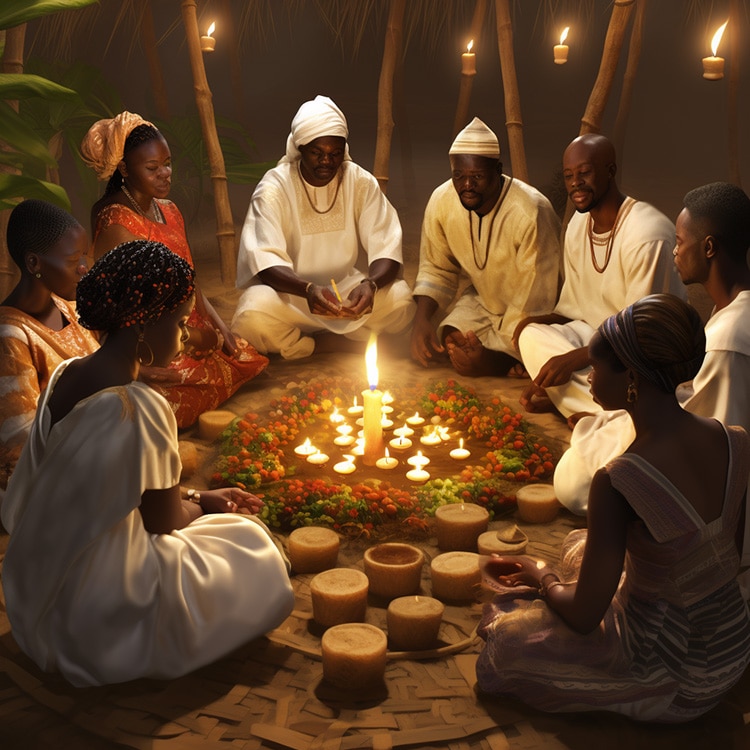
Yoruba moyugba
The moyugba is divided into three parts. In the first, a greeting is offered to Olodumare, invoking his names and praising him for his divine creation and his omnipotence. Although some regard him as a silent and distant deity, in the Cuban Osha-Ifá tradition Olodumare is venerated in every ritual, for without the Supreme God nothing would be possible.
After paying homage to Olodumare, tribute is paid to two important ancestors of the Yoruba or Lucumí religion: Asedá (Ashedá) and Akodá, the first two disciples of Orunmila, who helped him spread the word of Ifá and his wisdom to all of humanity.
Finally, an invocation is made to time itself, acknowledged as an indispensable witness of humanity’s past, present, and future, and a petition is made for the continued existence of the world and of our species.
Afterward, we pay homage to our parents (Babatobi and Iyatobi), the two essential beings who make our existence possible. Yoruba culture, centered on the family, grants great importance and respect to one’s parents, who are cherished during their lifetime and continue to be honored after their passing. Indeed, our parents are as sacred as any orisha.
By venerating the Ancestors and the departed with the moyugba, or Song of Remembrance, during a ceremony or ritual, one receives the essence of their blessing and the ashé needed to achieve the desired results. Who are the Ancestors? They are the men and women who carried their religious beliefs with them from Africa to the American lands as a result of the slave trade. Despite the harsh conditions in which they lived, they managed to pass on their religious knowledge in such a way that their wisdom has outlived them and survived to this day, preserved and developed by their descendants in the New World.
For a moyugba to be effective, one must carefully mention all the names of one’s deceased blood relatives and loved ones, including friends, teachers, and people who were significant in one’s trade or profession.
To honor those who stood by us in difficult times, and the neighbors and acquaintances who are no longer with us because they departed and had some connection to our lives, various spiritual rituals and ceremonies are carried out. These attentions may range from masses to spiritual assistances, and it is believed that those who have passed away can help us from wherever they may be.
The moyugba is also a ritual used when a spiritual work is performed, to give notice of what is about to be done and to ask for support and protection from the spirits who accompany us. Before adding a name to the moyugba, it is important for the initiate to go to a sacred place of their choosing, including natural places, and ask for Light, Progress, and Spiritual Elevation for the departed connected to the ceremony. Each of them is named while the Spirits of Great Light are implored to help the officiant gather strength, so that they may assist him in his life and in whatever problems he may face.
The moyugba is performed with solemnity and spirituality, and within it is concentrated the believer’s own spiritual force, together with the great mystical currents that flow from departed relatives and ancestors. It is important to remember that in the moyugba one must gather the whole of one’s faith, along with sound and purposeful actions, to achieve the desired goal.
Here is a possible version of the text to avoid duplication in search engines:
For the initiate, it is essential to establish a harmonious connection between their spiritual-material body and the spirits who accompany them. The spirits around us deserve the same respect as the orishas, so it is important to attend to them and keep them satisfied. In the religions of African origin in Cuba, the veneration of the dead and of the ancestors is one of the fundamental pillars.
In Osha-Ifá it is said that «EL MUERTO PARE AL SANTO» the dead give birth to the saint, which is condensed in the saying IKÚ LOBI OSHA. Therefore, before invoking, asking permission, giving notice, or beginning any rite or ceremony, a moyugba must be said. This stems from the belief that all the orishas were once living beings. The departed one of greatest standing and highest spiritual rank is Oduduwa, who is considered to stand almost at the same level as Olofin.
Moyugba
«Omi tuto Ana tuto Tuto, eggun Tuto, laroye Tuto, owo Tuto ile, Ariku babawa».
Con la bendición Olofin, Con la bendición Olorun, Con la bendición Olodumare, Con la bendición de mi padre, Con la bendición de mi madre
Moyugbo asheda, Moyugbo akoda, Moyugbo a baba eggun, Moyugbo todas esas ciencias lagua lagua que están leri tocun, Moyugbo todas esas ciencias que guaicoco
Ibá é layén t’onú Walter Rafael Coche Velásquez– baba Leti, Ibá é layén t’onú Ester Guadalupe Márquez – Adde Oké, Ibá é layén t’onú Ramón Lisi – Baba Akodie, Ibá é layén t’onú Bebo More – Omi Ladde, Ibá é layén t’onú Martin Pacheco – Yomi Yomi, Ibá é layén t’onú Gilberto Carrasco – Obba Yoko, Ibá é layén t’onú Domingo Gómez – Shangó Miwa, Ibá é layén t’onú Domingo Meza – Cocoro Aye, Ibá é layén t’onú Ana María Montes De Oca – Osha Inle, Ibá é layén t’onú Alberto La Cruz – Efún Bi, Ibá é layén t’onú Chiqui Valdez – Omi Dina, Ibá é layén t’onú Estelita Hernández – Oshun Feisita, Ibá é layén t’onú Bernardo Rojas – Oshe Pavora, Ibá é layén t’onú Miguel Padrón – Oddi Ka, Ibá é layén t’onú Isidro Valdez – Otrupon Meyi.
NOTE: (those present must answer IBAE after the name of each ancestor called)
Ibá é layén t’onú a todos esos seres Iya ocha, Baba Osha, oluwos siguayu que ara onu que tocù, que timbelese, que timbelorun, que timbelaye Olodumare mayor yumila; Bogbo ara onu a todos esos seres que acompañan, amparan y me protegen (xxxx).
IBAÉ LAYEN TONÚ GBOGBO ÉGUN ORÍ, BABALORISHA EMÍ: (the departed who accompany the Iyalorísha — my godmother — or the Babalorísha — my godfather)
IBAÉ LAYEN TONÚ GBOGBO ÉGUN ORÍ IWÓRO KALÉ ILÉ: (the departed of everyone present in the house. They are not named)
IBAÉ LAYEN TONÚ GBOGBO ÉGUN ara onu que acompañan, amparan y protegen a xxxxx
Kinkamashé – Mi Padrino – XXX
Kinkamashé – Mi Oyugbona – XXXX
Kinkamashé – El Oriaté – XXX
Kinkamashé – Mi Padrino De Mano De Orula – XXXX
Kinkamashé – Mi Padrino De Mayombe XXXX
Kinkamashé – XXX
Kinkamashé – XXX
Kinkamashé – XXX
Kinkamashé – XXX
Kinkamashé – XXX
Kinkamashé – XXX
Kinkamashé – XXX
Kinkamashé – XXX
Kinkamashé – XXX
Kinkamashé – XXX
Kinkamashé – XXX
Kinkamashé – XXX
Kinkamashé – XXX
Kinkamashé – XXX
Kinkamashé – Nelson Madrid – XXXX
Kinkamashé –XXX
Kinkamashé – XXXX
Kinkamashé – todos esos Santeros que pusieron Aché en mi cabeza, Kinkamashé todos los babalawos, las iyalochas y los babalochas mayores y menores que su bendición siempre nos alcance Ashe.
After praying to the Santo, the following is said:
Mi padre (nombre del Santo) aquí estoy (nombre cristiano y religioso del Santero) pidiéndole la bendición y permiso para darle conocimiento que el día de hoy su omo (nombre de la persona) esta umbo a sus pies para (se le da conocimiento de la ceremonia) para que sea usted que lo libre de ikú unlo, aro unlo, Ofo unlo, Iña unlo, achelu unlo, Fitiwo unlo, y de bogbo ogsorbos unlo que puedan perjudicarlo y le de iré owo, iré omo, iré aye, iré Ashegun Ota, iré ilé, iré Arikú.»