Oduduwa
3.133 words 15 min read
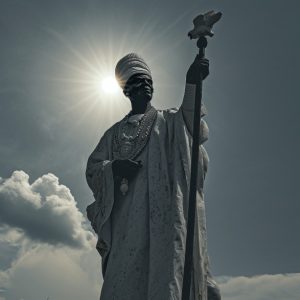
Oduduwa is a legendary figure in Yoruba mythology and is regarded as the father of the Yoruba people. He is venerated as a powerful and wise leader who played a central role in the founding and development of Yoruba civilization. In this article we explore his life, his legacy, and his cultural significance within Yoruba mythology.
-
The origin story of Oduduwa. According to Yoruba mythology, he was a divine being sent by the supreme god Olodumare to create the earth and establish the Yoruba people. He descended from the heavens on a chain, carrying a rooster, a handful of soil, and a palm nut. He used the soil to create land and the palm nut to plant a tree, which grew into the first palace of Ife. The rooster symbolized his ability to command the forces of nature.
-
Oduduwa as father of Yoruba civilization. Oduduwa is regarded as the father of the Yoruba people and the founder of the kingdom of Ife. He is credited with bringing civilization to the Yoruba by teaching them agriculture, metalworking, and other crafts. He is also known for establishing a system of government and fostering peaceful coexistence among the different Yoruba clans.
-
The descendants of Oduduwa. It is said that Oduduwa had several wives and children, who became rulers of the various Yoruba kingdoms. His descendants are known as the «Ooni of Ife» and are considered the spiritual leaders of the Yoruba people. The Ooni of Ife is also believed to be a direct descendant of Oduduwa, responsible for upholding the customs and traditions of the Yoruba people.
-
Oduduwa in Yoruba art and culture. Oduduwa is a prominent figure, with many sculptures and carvings depicting him as a majestic and powerful leader. He is also celebrated at the annual Oduduwa festival, held in his honor in the city of Ife. The festival includes music, dance, and other cultural activities, and it is one of the ways the Yoruba people honor their heritage and pay tribute to their ancestral father.
-
The legacy of Oduduwa lives on in the traditions, customs, and beliefs of the Yoruba people. He is venerated as a wise and powerful leader who brought civilization to the Yoruba and established a system of government that fostered peace and unity. His descendants continue to serve as spiritual leaders and custodians of Yoruba culture, ensuring that his legacy endures for generations to come.
History of Oduduwa
When Olofi set out to make the world, he came down with Obatalá (that Obatalá is the eldest of them all: Obatalá Odduá). In the enthusiasm of creation, Olofi made marvelous things (such as the ceiba, the clouds, and the zun-zun bird), but he also had failures and left other things half finished. Human beings, for example, he left without heads. Naturally, they wandered without direction and the world looked like a madhouse. Annoyed, Olofi charged Oddúa with making heads for them. He made them, but left them with a single eye. Ibá-Ibó had to come to place their eyes where they are now, and to give them a mouth, a voice, and the power of speech. Then human beings began to be as we know them, and all seemed well.
Characteristics and attributes
Odduá is recognized as the first king of Oyó and the eldest of the dead. He is also considered the first king of the Yoruba and of Ifé. This orisha embodies the mysteries and secrets of death; his color is white, he is the owner of solitude, and his nature is androgynous. Odduá, Oddún, and Orula are brothers who are always together and form a trinity. Through Odduá one comes to know Olorum and to intuit Olofi. His wife is Odduaremú or Oñó-Oró, who is syncretized with Saint Anne, patroness of the dying and of women in childbirth. In some cases, he is also regarded as a manifestation of Obatalá
Odduá is venerated for his role as creator and dispenser of justice. He is not an orisha given by santeros or lesser priests, but by babalawos. Unlike other orishas, he is not seated directly on the heads of his children; rather, it is Obatalá the saint from whom they are born. Odduá is considered a path of Obatalá, one of the most ancient of the 16 Obatalá who reside in Iroko. He personifies a divine, impersonal principle of power. Through Odduá one can come to know Olorum and perceive Olofi.
When Odduá is received, an extendable Ozún is used, consisting of a round, heavy, firm base with an extendable rod adjusted to the owner’s height and a round cup at the top. The lid of the cup is decorated with a dove. In the Arará tradition, he is called Odduá Daa.
Odduá is an orisha of great importance and singularity in the Yoruba religion. His symbolic representation through the Ozún and his association with justice and deep knowledge make him an orisha venerated by babalawos and a figure of great weight in the religious tradition.
- Jet, coral, amber, mother-of-pearl, and ivory belong to him. These materials form part of the ashé of the cup and are used, together with white beads, in the making of his necklaces.
- A white horse; 16 stones from a river, hill, or path; 36 cowries, though he does not speak through them; and a lamp prepared with almond oil that is lit for him every Thursday.
- A sphinx of the Blessed Sacrament, a silver sword and machete.
- Colors: white, red, and black
- Day: Thursday. Number: 8
- Greeting: His children salute him lying face down with their arms pressed against the
body, saying: Aremú Odudúa jekuá Odudúa (Chief of the first rank)
The sopera or chest of Oduduwa
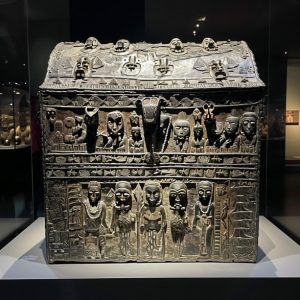
He is kept in a metal chest made of silver, steel, or nickel. This chest represents the mystery of what lies hidden and unknown in this life and the next, forbidden to human beings. Out of respect for that knowledge concealed within the chest, it is kept permanently closed with a padlock that must measure 10 inches wide.
Inside the chest, which is never opened, a metal skeleton is placed. It is not a symbol of death but a teaching on the brevity of life — a dynamic death that heralds a new immortality. It symbolizes the wisdom of one who has crossed the threshold of the unknown and interpreted the message of divine harmony. The chest also holds the secret that was previously used in the ceremony of Odduá. The skeleton is covered with ceiba cotton and the chest with a white cloth. His receptacle is then placed somewhere high up. Odduá lives on the hill, wrapped in ceiba cotton, and cannot endure sunlight.
Offerings
Animals he eats: The same as Obatalá. Odduá and Obatalá eat together. When he eats, he does so with the chest closed, all the blood being received by the sopera (lidded tureen) and the cowries of Obatalá, which are the ones that will speak in the itá. He is offered a white she-goat, hen, quail,
guinea hen, and doves — the latter numbering 101 when the orisha is received.
Herbs
All plants that grow one upon another belong to him.
- White lily
- White bleo
- Peregún
- Egüé Teté
- Cotton
- Flor de agua
- Curly bleo
- Purslane
- Almond,
- White canutillo
- Campana
- Egüere Egún
- Mata de pincho
- Prodigiosa
- White elderberry
- Peonía
- Basil
- Corazón de paloma
- Anón
- Guanábana
- Mint
- Lemon balm
- Marjoram
Tools of Oduduwa
The tool of Yemú or Yembó with the staff is a cedar coffin 8 inches long by two inches wide, containing a silver skeleton. This is because Oddúa represents those who have died and passed into the world of truth. There are 8 staffs (paoyé), 8 rings (Odanes), and in some houses of the religion, the shields and rings represent the planets closest to the earth and the 6 most important orishas, with whom they hold an astral correspondence. Orula is Saturn; Obbatalá is Jupiter; Oggún is Mars; Changó is the Sun; Ochún is Venus; Elegguá is Mercury; and Yemayá is the Moon. The 6 shields represent the power of these celestial bodies and are used by the orishas to defend themselves in wars and survive on earth.
In addition, there are 8 triangular shields; a large triangular shield with an eye at its center; a ladder 8 inches tall; a serpent roughly 4 inches long representing the mistress of the secret of life and death, which also stands for a higher stage of consciousness or inner vision, as well as the ability to survive and to lead through others in the universe. There is also a set of Obatalá’s tools; a male and a female figure 4 inches tall symbolizing creation and the perpetuation of the species; 8 white Chinese stones; an ivory ball (some houses place two); a mother-of-pearl ball; two hands of 18 cowries each; and 8 used dice. A terrestrial globe is also used as a symbol of perfect creation, along with an iruke made from the tail of a horse, elephant, or deer, its handle bearing two central grips formed by eight rings of white, black, red, and yellow beads.
Necklaces
There is one type of necklace, 18 inches long, made of mother-of-pearl beads which, for those who know how to read the legends, represent the paths and their incidents. Another type has 8 sections of milk-white beads to mark the paths. These sections are separated from one another by two mother-of-pearl beads with a coral bead in the middle. A third type carries 16 white beads and 8 red ones, and a fourth carries 16 water-and-soap beads, and so on until the desired length is reached.
One necklace of these types measures 33 inches long and is composed of 16 white beads, 8 red, 8 mother-of-pearl, and 8 coral, interspersed. Another commonly used necklace has 8 white beads, 2 mother-of-pearl, and a coral bead in the middle. There is also one made with 16 white beads, one red, one jet, one coral, one mother-of-pearl, one ivory, one amber, and a silver coin, all interspersed with white beads. Another includes four green beads, four white, and one green and one white interspersed. It may also be 16 white beads and 16 green, with mother-of-pearl and ivory interspersed.
Syncretism
- Syncretism: the Name of Jesus and the Blessed Sacrament.
Prayer
Oluwa Oduduwa, olori aye ati olodumare, awa ni oruko re, awa yoo ni iyin si re, awa yoo fi oruko re han ni gbogbo ile aiye, Oluwa Oduduwa, ayo re ma bawa wa laarin awon ibere aiye, a o ni se afi ibi ti aye ti tun gbe wa pada, a o ni je obi ti o da fun wa, a o ni je edun abo ti o da fun wa, a o ni je epo ati osun ti o da fun wa, Oluwa Oduduwa, wa yin wa daada, amin
Translation
O great Oduduwa, owner of the earth and creator of humanity, we invoke you in this moment of need and tribulation. You who are the father of the orishas, guide us and protect us on our path. Pour out upon us your wisdom and your divine light, so that we may overcome the difficulties that come before us. Help us find balance and harmony in our lives, and allow us to live in peace and prosperity. Oduduwa, hear our prayers and bless us with your divine grace. So be it.
Song
BABÁ AREMÚ ODUDÚA AWOMÁ ARELÉ AGOLONÁ. AREMU AWARISA AWOMÁ ARELÉ
OKUÓ AGOLONÁ. AGOLONÁ O AWADEÓ OKUÓ AGOLONÁ BABÁ AREMÚ ODUDÚA AWO MAARELÉ
AGOLONÁ. AREMÚ AWARISA AWÓ MARELÉ OKÚ O AGOLONÁ-AGOLONÁ O AWADEÓODÚ AREMÚ IRÉ AWARISA
Translation
Father who was born first, the chief who created all things; the mystery increases his strength. Make the way for me, the first to be born. We come to you, chosen head; the mystery increases the strength.
Long life to you, make the way for me. Make the way for me; we have come to crown you. Long life to you, make the way for me. Father, the first to be born, chief of his own existence. The mystery that keeps increasing its strength.
Step aside to take the way; we, the firstborn, go to the chosen head; the mystery keeps increasing the strength. Long life to you; step aside to take the way; we have come to crown you.
The supreme head, the firstborn, well-being. We come to the chosen head.
Paths of Oddúa according to Ifá
- Oddúa: The Most Holy (Obbá Brumú). He is the direct son of Oloddumare and represents the solid land of the planet, while his complement is the water and the oceans of the planet (represented by Yemayá Yembó). Life came about through the union of these two beings, from whom all the orishas were born.
- Oddúa Oko: He is the final stage of Obbatalá Brumú on earth and carries a snake, a silver chameleon, a doll (in some houses two dolls, female and male), a bracelet, a bell, 2 hands, two feet, a heart, 2 kidneys, a scythe, and a cup with an eye mounted in silver. To light his lamp every Thursday, a box of wicks and almond oil are needed.
- Oddúa Ayágguna: He is the deaf one. In his sopera are placed 2 whistles, one open and one closed, and the diloggún strung on a silver wire. He is washed only with the shoots of Orula’s palm. He lives at the top of a palm tree.
- Oddúa Abelli Lukoso: He carries two stones and the usual tools of Obbatalá. He lives on the roof and goes in a woven bag inside the room. His tools are dressed with fish and parrot feathers, and both the tools and the Diloggún are doubled.
- Odduá Olukó: His receptacle holds 32 cowries (two hands of 16 cowries). He eats seven kinds of rooster and carries San Ramón sticks at his side, in the form of a two-faced staff with mouth and eyes made of cowrie shells with the opening facing inward, symbolizing eyes that do not see and a mouth that does not speak. He also carries a skull, even if only a small piece, a rosette and a helmet, a scythe, a saber, and up to 16 guinea-hen heads, though only two may be used. Each guinea-hen head is dressed with white beads, leaving the eyes and the beak exposed.
- Oddúa Odofatolo: He carries a shield engraved with an eye, surrounded by rays of the sun and with an eye at the center. He eats two she-goats. After the ceremony, the hide is tanned and the tools are covered with it. Sixteen holes are opened in the hide, and a parrot feather is placed in each one.
- Oddúa Ataná: In addition to his tool and the almond-oil lamp, he carries four silver candles and four yellow ones. He must carry 2 sets of four small, flat drums of silver or ivory. He wears a band of cowries over leather on the lid. All plants or herbs that grow one upon another belong to Oddúa.
- Oddúa Apitico-Abelli: He carries all the tools proper to Oddúa and those which, belonging to other paths of the same Oddua
- Oddúa Apitico-Abelli: He carries all the tools proper to Oddúa and those which, belonging to other paths of the same Oddúa, he may wish to add. The whole body of a quail is placed with him, and he carries a bit of everything.
- Oddúa Ariwó: He is very communicative, and in addition to the tools proper to Oddúa, bells and noise-making objects are added (whistles, rattles, bells, etc.).
- Oddúa Obaibó: In addition to Oddúa’s tools, he carries ladders and curved staffs made of silver or silver-plated metal. He also carries six eyes of cowries or crystals mounted in silver.
- Oddúa Akarán: (Okarán) carries the usual tools of Oddúa and Obbatalá, but pieces crafted from cedar and silver combined are also incorporated. For example, his ladder is wooden with silver rungs, and his rattle is wooden with silver bells.
- Oddúa Akualosiña: He must have a white sopera decorated with one open eye and four closed ones. Over the sopera is placed a silver chain or thread 80 cm long, adorned with 16 white beads strung roughly one inch apart.
- Oddúa Akuesí: carries the usual tools accompanied by a necklace of white beads adorned with a silver skull hanging from the sopera. He always walks with Babalú Ayé.
- Oduduwa Abaña
- Oduduwa Abere
- Oduduwa Abeyi
- Oduduwa Abipá
- Oduduwa Abitu Laye
- Oduduwa Adaguele
- Oduduwa Adakini
- Oduduwa Adakinikala
- Oduduwa Agbadekan
- Oduduwa Aguele
- Oduduwa Aguema
- Oduduwa Aguesí
- Oduduwa Ajeré
- Oduduwa Akala
- Oduduwa Akambí
- Oduduwa Akana
- Oduduwa Akashimiluwo
- Oduduwa Akuarosina
- Oduduwa Alabó
- Oduduwa Alabuweje
- Oduduwa Alakaiyé
- Oduduwa Alakanilowo
- Oduduwa Alashuadá
- Oduduwa Algwana
- Oduduwa Alikkan
- Oduduwa Aliluwo
- Oduduwa Apitiko
- Oduduwa Aremí
- Oduduwa Aremu
- Oduduwa Asesú
- Oduduwa Awá Pepó
- Oduduwa Awadekan
- Oduduwa Ayalá
- Oduduwa Ayema
- Oduduwa Ayemolú
- Oduduwa Ayorikan
- Oduduwa Baba Yegun
- Oduduwa Dana
- Oduduwa Desí
- Oduduwa Dishé
- Oduduwa Diyeleó
- Oduduwa Diyoko
- Oduduwa Ejemú
- Oduduwa Eletí Barayé
- Oduduwa Emí
- Oduduwa Erú eó
- Oduduwa Fatolo
- Oduduwa Ibaibo
- Oduduwa Ikalambe
- Oduduwa Itaná
- Oduduwa Iyá Agbé
- Oduduwa Molé
- Oduduwa Moshale
- Oduduwa Naná
- Oduduwa Obaiño
- Oduduwa Obeikú
- Oduduwa Obejú
- Oduduwa Odisha
- Oduduwa Ofun Foye
- Oduduwa Ogueré
- Oduduwa Okelekedewewe
- Oduduwa Ologbeyé
- Oduduwa Olokun
- Oduduwa Olukosa
- Oduduwa Omela Ikú Babá Yeyé Aslashé
- Oduduwa Oré Okó
- Oduduwa Orisayé
- Oduduwa Orisha Ayé
- Oduduwa Orumare
Patakí of Oduduwa
Legend has it that Oduduwa, the father of the orishas, came down from heaven to earth upon a chain of snail shells. It is said that he brought with him the power of creation, knowledge, and wisdom to teach humanity to live in harmony with nature and with one another.
Oduduwa settled in the region of Ile Ife, in what is now Nigeria, and there he founded a prosperous and just kingdom. It is said that he taught his people to farm the land, to build homes, and to live in peace and harmony. Oduduwa also taught the Yoruba the worship of the orishas, and how to ask them for help and protection in times of need.
After many years of just and wise rule, Oduduwa withdrew to heaven, leaving his son Oranmiyan as his successor on the throne of Ile Ife. It is said that, even after his death, Oduduwa continues to protect and guide his people, and that his wisdom and knowledge have been handed down through the generations.
This patakí shows the importance of Oduduwa in Yoruba religion and culture, as the father of the orishas and the founder of the kingdom of Ile Ife. The story of Oduduwa is a reminder of the importance of living in harmony with nature and with other human beings, and of the need to seek the help and protection of the orishas in times of need.