Obbá Naní
1.593 words 8 min read
Home
Obbá Naní, orisha of love
Obba Si Eleko Eni Obba Ofe Re Lekun Fe Enu Lafinda Farawa Obba Obi Arin Nina Oju
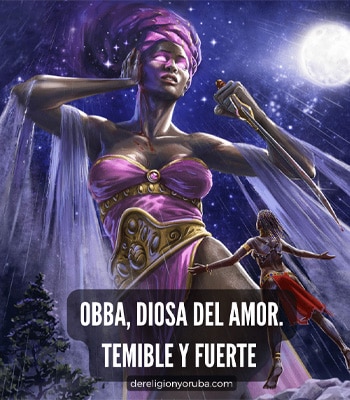
Obbá Naní is a major orisha. She belongs to ilé Ikú (the house of the dead) and is connected to all things spiritual. Together with Yewá and Oyá she forms the trilogy of orishas who dwell in the cemetery. Obbá Naní is a warrior orisha, owner and protector of lakes and lagoons. Eternally in love with Shangó Alafí, her love for him drove her to cut off her own ear; and when she was repudiated for that act, she withdrew into solitude, into the cemetery, becoming the guardian of the tombs. She is neither crowned nor does she mount her devotees, although some santeros claim to have done so. Her meaning within the religion is tied to everything that is knowledge in this world.
It was she who taught all the orishas the art of war. She taught Shangó to wield the double-edged weapon, which is bound to the symbolism of the lightning bolt — the force that ignites, illuminates and destroys at once. She taught Oggún the anvil, symbol of construction, used to forge and temper weapons. The anvil represents the passive femininity from which the blacksmith’s works must emerge.
Obbá does not speak on the mat. Her cowries only touch the ground when they are washed at itá, and she speaks through the mouth of Oshún. Obbá is the symbol of love and of marital fidelity, and she is depicted as a young, sensual woman of firm flesh. This orisha should not be received by young people. She is not crowned; she is only received. She does not dance, but when she descends she covers her face with a mask. She originates from the land of Tákua.
The Story of Obbá’s Ear
According to legend, Obbá was one of the wives of Shangó, the powerful god of thunder. Obbá, hoping to win even more of Shangó’s love and attention, sought advice from Oshún, another of Shangó‘s wives, known for her beauty and charm. Oshún, driven by envy and wishing to undermine Obbá, falsely told her that Shangó would be pleased if she cut off her ear and served it to him in a stew.
Obbá, trusting Oshún‘s advice, went ahead and cut off her ear and prepared the stew for Shangó. When Shangó discovered what Obbá had done, he was filled with horror and repudiated her, which led Obbá to flee and take refuge in the kingdom of her father, Obbatalá. In some accounts, it is said that her tears of grief created rivers and lakes.
Obbá’s Family
Her parents are Obbatala and Yembo; she is the sister of Yewa and Oyá and the devoted lover of Shangó, for whom she cut off her ear. She was banished and went to live in the solitude of the cemetery. She gave the anvil to Oggún, and in exchange he taught her the art of war.
Tools
Her vessel is a pink porcelain jar adorned with flowers. Her attributes are a wooden anvil, a dagger, a hand of cowries, a shield, two keys (one lives inside her sopera (lidded tureen) and the other in Oshun’s), a mask, a helm, a book, a breastplate, two twisted bracelets and an ear, all in copper. Her elekes (the necklaces) are strung with 8 pink beads, 1 black, 8 lilac, 1 black, 8 yellow and 1 black.
Obbá’s Objects of Power
She wears 5 gold bracelets, like Oshun.
Offerings to Obbá
Raw yam is presented to her as an offering. The animals sacrificed in her honor must be anointed with corojo butter, grape, plum and cascarilla, among others. This orisha eats castrated goat, hen, guinea hen and pigeon. Her Ewe, or sacred herbs, include coastal hazel, sea grape, mahogany, caobilla, chestnut, plum and caponero ebony.
Obbá’s Dance
This orisha does not take part in dances. Dances are performed in her honor, since this orisha does not manifest directly. During her dance, a person wearing a mask is placed at the center of the circle of dancers, and lashes are mimed upon them while the chorus sings.
Traits of the Omo Obbá
The women are brave and often misunderstood, with a diversity of traits that may include some considered masculine. They may face challenging experiences in love and can be jealous in certain circumstances. They have the capacity to achieve material success, and some of them stand out as defenders of women’s rights, feminist leaders or activists.
Paths of Obbá
- Obbá Laddé: This incarnation is Obbá the Sovereign, the crowned consort. She is associated with the rocks along riverbanks and also along the seashore.
- Obbá Mire: This form of Obbá brings her gifts from the element of water. She is distinguished by carrying a machete and a shield as symbols of her strength.
- Obbá Lubbe: This version presents Obbá as a formidable, battle-hardened fighter, noted for her use of bladed weapons in combat and defense. She manifests particularly at the side of Changó and is renowned for her vast knowledge of the occult arts and witchcraft, an inheritance from the lands of Ijesá. She is frequently invoked to break curses or to free people from unwanted romantic unions. Among her tools are a magic broom, a wand and a mortar, and a five-pointed star is engraved on her copper bracelets.
- Obbá Tolá: She belongs to the high aristocracy of the palace and is revered for her abundant wealth.
- Obbá Tundé: She is the monarch who returns from her travels to bring help and counsel to her devotees.
- Obbá Omí: Emerging from the waters, she dwells along the banks of rivers and sea coasts, always favoring places with vegetation or nearby woods.
- Obbá Yurú: Famous for having cut off her ear for the love of Changó, showing a vengeful side.
- Obbá Labbí (Labbí Ikú): Known as the one of the dark tomb. She is highly revered in the high magic rituals of the Lukumí, associated with the Eggúns and Iwin. She is devoted to malevolent works, though on rare occasions she acts as a benefactor. A double-edged razor is attributed to her. She has numerous paths within these practices, and it is advised not to bring her into houses of Ocha because of the serious disturbances she can cause, as she does not get along with any orisha. She has a greater affinity with mayomberismo.
- Obbá Guirielú: Represents Obbá when she dwells upon a stone in a lake. According to legend, when she tried to cast into the lake of Olossá an ebbó prepared for Changó, the wind blew it back and it landed on a great stone. There she remained, weeping and sighing for him. It is said that at times her laments can still be heard on the wind in that place. Offerings in this domain are usually related to the return of a loved one, family unity, or the return of a child.
- Obbá Bomi: Represents Obbá in her calmest and most peaceful aspect, associated with the serenity of still waters.
- Obbá De: This path shows Obbá in a more ceremonial and regal facet, frequently linked to leadership and authority.
- Obbá Niké: Here, Obbá manifests as a protector and guardian, focused on the safety and well-being of her followers.
- Obbá Laiyé: This aspect of Obbá highlights her connection to the natural world and everyday life, showing a more earthly, approachable side.
- Obbá Yeyé: On this path, Obbá reveals herself as a maternal, nurturing figure, devoted to the nourishment and care of her devotees.
- Obbá Lasé: This path emphasizes Obbá’s power to influence the spiritual and physical worlds, often invoked in rituals of empowerment.
- Obbá Beremi: Here, Obbá appears as a spiritual guide and counselor, bringing wisdom and direction to those who seek her.
- Obbá Suaré: This path highlights Obbá’s ability to overcome obstacles and hardship, symbolizing resilience and strength.
- Obbá Taladé: Represents Obbá as a traveler and explorer, symbolizing the search for knowledge and adventure.
- Obbá Labaiyé: This aspect of Obbá is centered on life and creation, often associated with fertility and growth.
- Obbá Olomi: On this path, Obbá is closely bound to the element of water, symbolizing purification and renewal.
- Obbá Suemi: Here, Obbá appears as an orisha who brings comfort and relief, especially in moments of affliction or sorrow.
- Obbá Bi: This path highlights Obbá’s dual nature, balancing aspects of light and darkness within her character.
- Obbá Biolomi: In this manifestation, Obbá is associated with
- Obbá Biolomi: This manifestation of Obbá is closely tied to the mysteries and depths of the water, symbolizing introspection and hidden knowledge.
- Obbá Funmi: On this path, Obbá reveals herself as a source of joy and celebration, emphasizing the importance of enjoying life and its pleasures.
- Obbá Jare: Represents Obbá as a defender and protector of justice, focused on balance and moral rectitude.
- Obbá Omiota: Here, Obbá is associated with the force and power of moving water, as in rivers and waterfalls, symbolizing change and transformation.
- Obbá Nupe: This path refers to Obbá’s origins in the Nupe region, the land of Takua, highlighting her connection to her ancestral roots.
- Obbá Odeyi: In this form, Obbá manifests as a huntress and warrior, symbolizing skill and cunning.
- Obbá Funke: This aspect of Obbá highlights her role in celebration and entertainment, often associated with music and dance.
- Obbá Tunese: Represents Obbá in her facet of change and evolution, highlighting her capacity to adapt and transform.