Aggayú
2.044 words 10 min read
Aggayú, lord of the volcanoes
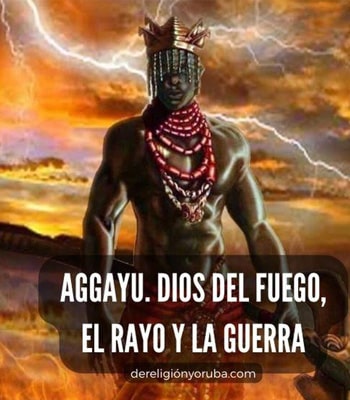
Aggayú is the son of Oroiña, and some consider him the father of Shangó and Orungán. One patakí (traditional story) tells that Aggayú Solá, lord of the volcanoes and of the river currents, was a powerful and feared giant. He would help people cross the waters, but always demanded payment. Once, after he helped Yemayá and she had nothing to pay him with, she lay with him so as not to enrage him. From that union Changó was born, though Aggayú never knew of it. Arggayú, Algallú, Agayú — different ways of naming the same orisha. His name means Power of the World. He is born in the depths of the dry earth, and the earthly forces he commands are the symbol of his tremendous energy.
The lava that pierces the earth’s crust; the power of the rivers that carve territories apart and, when the waters swell, can destroy whole towns; the earthquakes that shake the crust of the earth; and the impulse that drives the energy of the earth itself and keeps it turning eternally. This giant of the Osha is the deity of the desert and the patron of roads, porters, drivers and aviators. He is also lord of the river and of the waters that plunge from on high (waterfalls).
He is the force of the rivers that cuts furrows into the earth; he is the riverbed and the force that opened it. He also represents the power of erupting volcanoes. He was born of the fire that gave origin to the earth and the sun, being one of the children of Oloddumare. Agayú appears as the one charged with transporting souls in their passage between life and death.
This orisha is the staff of Obatalá. Oroiña is his mother, for the volcano is born from the center of the earth, and he is ocanini with Oyá — one same heart and purpose — because both are orishas tied to the most essential elements of life: fire, air, the sun, life and death. He is also found in the great oceans, where the venerable Agana Okúm reigns, because Agayú, who is the volcano, walked those depths before she established her kingdom there.
Like Oyá, he receives several kinds of offerings, such as: feeding a well, an old crumbling wall, a house in ruins, the earth, a ceiba tree and the cemetery.
Strong-tempered and virile, he is one of the most respected orishas in the signs of Ocha. Agayú is a powerful orisha, as much a warrior as Shangó, only that unlike him, he never went to war with Oggún. He is an orisha who fosters harmony, and he is often received together with Shangó for the sake of their concord. When he finds himself in a difficult situation, his refuge is the palm tree.
He cannot be crowned on anyone’s head.
Characteristics of Aggayú
Symbol: The sun, the desert
Number: 9
Animals he eats: Roosters, bull, ducks, turkeys, deer, goat, calf, lions, zebras.
Color: Red
Day: Wednesdays, and the 16th of every month
Parents: Oloddumare and Oroiña
Herbs: San Cristóbal (both the stick and the herb — he shares it with no other orisha), abrojo del camino, rompe hueso, verdolaga, sabanilla, clavo, caña fístula, azafrán del monte, cebolla, cresta de gallo, corojo, guajaní, embeleso, bledo rojo, atiponlá or moco de pavo, platanillo de Cuba, zarzaparrilla, paraíso, álamo, jobo, curujey and papo.
Salutation: See the prayers. AGAYÚ CHOLA KINIGUA OGGE IBBÁ ELONÍ. (A salute to Agayú, king of the river and the savanna.)
Syncretism: Saint Christopher
Sopera (lidded vessel): He rests in a wooden or clay basin decorated with his nine colors. When a person has this orisha made, it holds 9 tools that accompany the stone, or fundamento, arranged in a pyramidal shape or another form suggesting the rising of the earth. Along with the tools, it holds a hand of cowries.
Offerings to Aggayú
Nine large crackers spread with corojo butter (palm oil) and fruits of every kind, with a preference for eggplant.
Attributes
A red-and-white double-bladed axe adorned with yellow, red and blue beads, two young-bull horns and 16 mates (rounded seeds found along the seashore).
Elekes (necklaces): Beads of cacao color, matipó, pearl, turquoise blue, one red bead and, at times, one yellow or green. In other houses of santo one may see strands of cacao-colored beads alternating with matipó every nine beads; others are made of red, turquoise-blue, green and yellow beads; and still others carry one large white bead followed by 9 red and 8 yellow, an order repeated several times.
Tools: A double-bladed axe with a staff. When he is of fundamento — that is, when the believer has him made — six tools of Shangó are added. In that case the orisha carries 9 tools of his own.
Illnesses: Blood pressure and fevers. Also automobile accidents.
Clothing: Trousers and jacket of dark red. From his waist hang kerchiefs or strips of many colors.
Characteristics of the children of Aggayú
Violent, quick-tempered and physically powerful. Tenderness tends to disarm them. They are friends of children, and the men are easy prey for women of fragile appearance, because they supposedly need protection.
Prayers
Prayer 1
Agayú Agayú aburo oro obini Oricha cheveroni aché Shangó omo cullate obini aché Changó aburo Dadá ayuba.
Prayer 2
Agayú Ichola quinche alueco babba, mo fe yo o sioro, apa oche a lu mi ne aguo sacocholo amo ibo yu ro, cuele, cuele idemi unsero ba lu ba lu mi bo lo inle
orira a caraballi omo ni.
Translation
Agayú Solá, we come before you, Father, to ask for your protection; we desire abundance of food, of drink and of everything we need. Hear our word; we ask your permission to bring this offering before you. Protect me, and those who are mine; free us from sorrows, from pain and from chains. Protect me on my way home. You, who always wipe away the sorrows of us, your children.
Songs
AGGAYÚ SOLÁ KINIBA O ALLAGE DE EWI ONISA O EWI ONISA ASOGÚN EWI ONISA YAWESE O AKARA SOLA KINIBA OLOWUYÉ MODANKI O
TRANSLATION
The wild one who makes wealth, the one greeted as a king, the one who opens the road to arrive. Please, let the owner of respect speak; the one who turns it into medicine. Please, let the owner of respect speak; turn around to wash me with soap. Great is the noise made by the one who makes wealth, the one who is greeted as a king. You who use renown to mark yourself as chief, I act only to salute you.
Stories
Agayú Solá was a powerful and feared giant: the lord of the river that plunged from on high. He used to help people cross the current, but he always demanded payment. On one occasion he did the favor for Yemayá (others say it was Oshún), who had nothing to pay him with and had to lie with him to appease him. From that union Shangó was born, though Agayú never knew of it. The giant was so feared that he left the door of his house wide open; though it was stocked full of provisions and fruit, no one would have dared to enter.
One day, however, Shangó — who is very brazen — slipped into the house, ate everything, and even lay down to sleep on the giant’s own mat. When Agayú came back from the fields and saw the spectacle, without a second thought he seized Shangó and threw him into a bonfire, which, of course, did not burn him. Then he picked him up and carried him to the seashore to drown him, but Yemayá appeared and, with great solemnity, let him know that this was his son. Even so, the troubles were not over.
On another occasion Shangó passed through Orunzalé and saw that the people of the town wandered about like zombies. Shangó was determined to find out who the king of that town was; after much effort, he discovered it was Agayú, and went to see him. «Why do you want to know who the king is?» said Agayú, enraged. And Shangó answered: «Father, it is that this town cannot bear so strong a king upon its head. Everyone is doing badly — they do not hear, they do not answer, they do not speak. I do not want them to keep suffering.» Thus they came to an agreement, and ever since, Shangó goes to the head of men while Agayú goes to the shoulders. That is why the children of Agayú keep that perfect communion with Shangó, and say: Shangó with oro for Agayú.
Works
PROGRESS AND PROSPERITY WITH AGAYÚ
MATERIALS:
- 9 spoonfuls of each of the following oils: cooking oil,
- almond oil, coconut oil, Palo oil, money oil,
- silver oil and gold oil.
- 1 box of wicks
- 1 clay pot
- 9 guinea peppers
- 9 dark copper cents
- 1 coconut soap
- 9 essences: Good Luck, Money, Silver, Heliotrope, Road Opener, Domination,
GAIN, ABUNDANCE, PROSPERITY — AND PROCEDURE
The center is scooped out of the watermelon and it is placed at the foot of the orisha; then the ingredients are placed inside one by one while the petitions are made, ending with the cooking oil. A wick is then set in the lamp and lit for nine days (the pulp is kept in a container at the foot of the orisha). On the last day, after leaving the lamp at the riverbank, take a bath with the pulp and cascarilla, lather with the coconut soap and rinse with plenty of clear water, finishing with water and a splash of all the essences mixed together, which have been left at the foot of the orisha during the nine days. Take nine baths.
Freeing oneself from enemies with Agayú
MATERIALS
- 1 quail
- 1 guinea hen
- 1 chicken
- 1 clay pot
- 9 guinea peppers
- 9 eggplants
PROCEDURE
The eggplants are placed in the pot at the foot of the orisha (asking that the enemy prosper elsewhere and go away). Then the quail, the guinea hen and the chicken are sacrificed over the eggplants. After the ceremony the animals’ heads are removed and set out to dry. The next day the eggplants and the sacrificed birds are taken to the edge of a road. Once the heads of the sacrificed animals are dry, they are ground in a mortar with the nine guinea peppers at the foot of the orisha, and the powder is then blown at the enemy’s door so that they go away.
For a cleansing
MATERIALS
- 9 cents
- 9 eggs
- Corojo butter
- Cocoa butter
- 9 perfumes: Pompeii, Money, Prosperity, Florida Water, Silver, Gold,
- Progress, Rose Honey and Good Luck
PROCEDURE
Blend the corojo butter and the cocoa butter in a double boiler. Then, with that prepared butter, rub the eggs and set them on a plate at the foot of the orisha. For nine days, perform a cleansing using one egg and one dark copper cent each day, passing them over the whole body while asking the orisha for protection and for everything bad to be driven away; the egg used for the cleansing is then placed on the other plate. Afterwards, bathe with soap and rinse with water prepared with the nine essences. On the ninth day, break the eggs at the foot of a dry tree with the firm thought that the streak of bad luck will break in the same way, and with the nine cents buy, at a ceiba tree, the chance of better fortune.
Luck bath
MATERIALS
- 9 flowers of different colors
- 9 small eggplants
- 1 coconut soap
- 9 cups of river water
- 9 cups of sea water
- 9 spoonfuls of honey
- 9 cups of spring water
- 9 spoonfuls of perfume
- 9 spoonfuls of holy water
PROCEDURE
Place one eggplant cut into nine pieces in a basin, along with one flower and the rest of the ingredients, and with this take a daily bath for nine days, lathering with the coconut soap. Rinse with clear water and, at the end, with the preparation; dress with some white garment for nine days.
To instill courage
MATERIALS
- Cresta de gallo herb
PROCEDURE
Cresta de gallo (the herb) is used to cleanse and make rogation, at the foot of Shangó and of Agayú, for men who are meek, timid or faint-hearted. Agayú and Shangó, through cresta de gallo, will instill in them their fighting spirit, their energy and what they lack most: courage.