Oggún
2.882 words 14 min read
The history of Oggún — who he is, his characteristics, his paths, works or ebbós, and patakíes
The history of Oggún. Who is he?
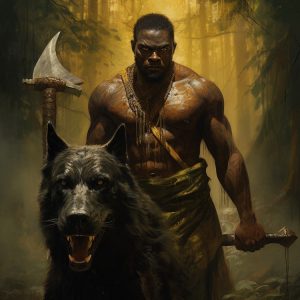
Oggún, around whom so many different stories have been woven, holds a mission of great importance in the Yoruba religion, because he is the Ochogun of all the Orishas — that is, the one charged with feeding them. The sacrifice is performed with the knife, which is nothing other than the representation of Oggún within the Santo. In other words, the blood that fills the soperas (lidded tureens) of the other Orishas passes first through Oggún, before it reaches the Santo who is being fed.
The mission of this Santo is to wage war on behalf of us all, in the religion and in life, for he committed a very grave offense by abusing his mother (Yembo). This moved Obatalá to try to curse him, but Oggún gave him no time and cursed himself instead. The curse was to sleep neither by day nor by night for as long as the world remains the world. He considers all women, including his mother, to be the same.
Oggún is a sorcerer and a warrior, like Shangó, and he proves it in wars. He is born from the bowels of the earth, for he is iron, and iron is born there too. The word Oggún means war and destruction, but also medicine and the spirit of both good and evil. He is an Orisha of ile Ocu and has much to do with the Eggún (the spirits of the dead). He is drawn to everything connected with the Dead and with sorcery.
He is indispensable to all the other Orishas, since he is the one charged with feeding them. His wife is Oya; to win her love he fought against Shangó. He had a love affair with Yemayá, whom he taught the art of love. The reason he considers all women to be the same is that Yemayá is his mother in her path of Yenbó. On earth he lives with Ochosi, by order of Obatalá, beside the door of the ile (the house), so that nothing evil may enter the home.
As the owner of iron, he holds one of the most important missions within the Yoruba religion: to be the ochoggún of all the Orishas, the one charged with feeding them the animals hunted by Oshosi. Indeed, all four-legged animals are sacrificed with Oggún’s knife, which is why this tool has become the most important representation of Oggún. The blood that fills the sopera of the other Orishas passes first through Oggún. His mission is to wage war on behalf of us all, both in the religion and in earthly life.
Oggún is a sorcerer and, like Shangó, he proves it in war. The sound of the name Oggún is a mantra; it means war and destruction, but also medicine and the spirit of both good and evil. He is an Orisha of the house of the dead and has much to do with them, for he deals with them and is fond of sorcery. He lives in the land of Oshosi by order of Obatalá, beside the door, so that nothing evil may come in.
Oggún, a major Orisha, is, like Shangó and Elegguá, violent and cunning. He is the king and owner of minerals, the mountain and tools, patron of blacksmiths, mechanics, engineers, chemists and soldiers. He is the God of minerals and mountains. Oggún is the brother of Changó and Elegguá, and he comes from the city of Ilesha.
Once a believer has received Oggún’s knife (Pinaldo) — the cowrie shell and the knife of Oggún — he is authorized to sacrifice animals in the ceremonies. Oggún represents the gatherer, the solitary, wandering hunter who roams the forest and knows all its secrets. He masters the mysteries of the wilderness like a sorcerer, but he also embodies the meat-eating warrior — rough, barbarous and bestial — who gradually evolves into the settled farmer who lives on domestic animals, root vegetables and fruit. His presence is that of a spirit both good and evil, one who provokes war and destruction but who also shelters medicine.
In the Rule of Ocha he speaks in the diloggún through Oggundá (a major letter). He is considered one of the oldest personifications among the Yoruba.
Characteristics of Oggún
- Color: Black and green, and at times purple.
- Day: Tuesday, Wednesday and the 4th of every month
- Parents: Obbatalá and Yemayá Yemmú.
- Greeting: MAFEREFÚN OGGÚN AGUANILLE AERERE.
- Symbol: Knife and anvil
- Number: 3, and 7 in combination
Animals he eats
The blood and feathers of red or white roosters. Rams and all four-legged animals. At times bulls are sacrificed to him.
Herbs
Campana morada, zarzaparrilla, rompe zaragüey (male and female), caldo santo, rabo de piedra, uña de gata, bibijagüa, guao, guanabina, guamao, palo bomba, black and red pepper, hierba hedionda, almácigo, escandón, higuereta, oak (the leaves only), picha de gato, jiquí, avocado, algarrobo, almácigo, atiponlá, almond, ceiba, dormidera, hierba de sangre, caña santa, galán de noche, mora, pegojo, huevo de gallo, anamú, romerillo, purple basil, palo manajú, ebony, cajuela, calalú, camagua, camarón, carbonera, abrojo amarillo, ácana, aguacate blanco, aguinaldo morado, ají chileno, cardón, cayumbo, ají de China, ají guaguao, arabo, árbol de piedra, árbol del cuerno, aroma, ayúa, bejuco moro, bejuco garañón, bejuco guaco, bejuco sabanero, bejuco San Pedro, caimitillo, comecaña, cuabilla, cuabarí, frescura, frijolillo, ginger, grajo, pomegranate, guano, guava, guisaso de caballo, jagüey, jocuma, corn, mano pilón, maravilla, mastuerzo, muralla, palo amargo, palo bronco, palo cabo, palo cochino, palo guitarra, palo rompe hueso, pata de gallina, pendejera, pimienta china, piñón de botija, quiebra hacha, siempreviva, tobacco, verdolaga, yerba diez del día, yerba fina, yuca, zarza blanca, higuereta and ciruela.
How Oggún is attended
Oggún lives alongside Eleguá and shares the same candle and many of the same offerings. Aguardiente is also blown over him, and tobacco smoke is offered to him. His tools are rubbed or lubricated with corojo butter while petitions are made to him. The tools are kept upright — a hammer, for instance, must be raised to a certain height before it can be used — but they must not carry too much grease (corojo), to prevent slipping and to keep them effective. It is important to remember that corojo should be added in moderation, and honey is never offered to him, because Ogún is not a «Sweet Warrior».
This Santo may be offered aguardiente, corojo butter, watermelon, sugarcane, pineapple, melon, and a jícara (gourd bowl) of water placed on Ogún to refresh him. The offerings remain for 7 to 21 days and are then discarded.
Syncretism
Saint Paul, Saint Peter, Saint John the Baptist, Saint George, Saint Michael the Archangel.
Sopera
Today the vessel most commonly used is a freidera identical to that of Elegguá — that is, a small clay pot — although traditionally it is a three-legged iron cauldron. Whenever an Oggún de fundamento is received, it always goes in an iron vessel.
Attributes
In general he is attributed all working tools and weapons made of iron: machetes, shovels, picks, hammers, mallets, anvils, hoes, rakes, drill bits, sickles, scythes, handsaws, nails, knives and spears, as well as pistols, machine guns, bombs, armed aircraft, cannons, and so on.
Elekes (the necklaces)
Of alternating green and black beads, or with seven light brown beads. In some cases this is set according to the house of santo. In Matanzas, for example, some houses make it with red and purple beads. In earlier times, leopard fangs were used, as well as purple beads. Once Oggún’s knife (pinaldo) has been received, there is authorization to sacrifice four-legged animals. In the case of the Oriaté (the masters of ceremony at the feasts of santo), cowries are added to it. His children wear a metal chain adorned with 21 pieces of Oggún, and some add the arrow of Oshosi. Worn across the body like the mayomberos wear theirs, they carry the collar de bandera (the banner necklace), and the santeros carry the mazo.
Animals that belong to him
The black dog and the snake.
Characteristics of his children
They are violent, impulsive people who do not easily forgive an offense. They never abandon a fight and never lose hope. They are unpredictable and difficult to deal with, but through their frankness and evident sincerity, they generally manage to make their flaws forgotten.
Clothing: it may be purple, or green and black. They wear a yarey-palm hat or a flattened cap. On the belt they also carry a long fringe of palm fibers called mariwó, which symbolizes protection against evil. They also carry a bag of tiger or goat skin adorned with many cowrie shells.
He was charged with being head of the family while his father was away, which affected him badly: he treated his brothers despotically and sexually harassed his mother.
Prayer
OGGÚN A TA RE A GUA BE-BE NI LLE OMO CAILE CO BI, OGGÚN A GUA NI LLE OMO O TOBALE A FE FUN OCHOSI ELQUIVE CA, ALBURE FUN IN YA IRE QUIEN ILLAN IRE QUIEN IDEYO BA NI OKE CUE MI O TO LA YA.
Translation
Oggún, we present you this offering and pray for your answer. Oggún, we are in affliction; we ask that, together with Ochosi, you drive away evil, sorrow and pain. Yours is the power; lift curses and turn evil aside. You who live in the wilderness, alongside the divine powers, fill my path with goodness and keep evil away.
Song
MARIWÓ YEYE, MARIWO YEYE O OGGUN ASÓ ALAGBEDE O MO WI MO BO NI MO BO OGGUN ASO ALAGBEDÉ.
Translation
Waving the palm fronds, waving the palm fronds — it speaks of Oggún the warrior. I say that I cover him with this and so I shall be free. The clothing of Oggún, the blacksmith. Today I will cover him with this and I shall be free. The clothing of Oggún, the blacksmith.
Patakí of Oggún
Oggún, the owner of iron, was an irascible, solitary man of the wilderness. When the Orishas came down to earth, it was he who took charge, with his tireless machete, of cutting through the trunks and the undergrowth to open the way for them. At that time he lived in the house of his parents, Obatalá and Yemú, together with his brothers Oshosi, Ozún and Elegguá. Oggún was in love with his mother and tried several times to violate her, which he failed to do thanks to the watchfulness of Elegguá. Oggún eventually found a way to achieve his purpose, but to his misfortune, Obatalá caught him. Before Obatalá could say a word, Oggún cried out: «I will curse myself. For as long as the world remains the world, the only thing I will do is work for the Ocha.» Then he went off into the wilderness with no company but his dogs, hid himself from men, and no Orisha other than his brother Oshosi ever managed to see him. He worked without rest, but he was deeply embittered. Besides producing iron, he took to scattering powders everywhere, and tragedy began to rule the world. It was then that Oshún went into the wilderness, drew him out with her song, and made him taste the honey of life.
Oggún went on working, but he lost his bitterness, never made powders again, and the world grew calm. Some say that when he came out of the wilderness, Oshún led him to Olorum, who bound him with an enormous chain — but that is only a tale. What chain could ever be stronger than the honey of Oshún?
Paths of Oggún
- Zarabanda: In Palo de Monte.
- Pungo Dibudi: In the Kimbisa rule.
- Oyo Oggún: Oggún’s full name
- Oggún Onilé: Countryman, farmer, landowner.
- Oggún Valenyé: Plowman
- Oggún Arere: The forger of iron and metals, and a warrior Orisha.
- Oggún Odé: A hunter of the Upper Paleolithic.
- Oggún Aguanillé: Owner of the wildlands
- Oggún Alaguedé. A black man of the wilderness, irascible and brutal. This is Oggún’s path as a blacksmith, associated with the forge and the making of tools.
- Oggún Aroke, Oloko, Olúkoló: The gatherer, the countryman, the farmer of the fields, the village peasant.
- Oggún Echibirikí: Jealous of Changó over the love of Yemayá; blood blinds him and drives him mad, and his ferocity and daring have no equal on earth.
- Oggún Arere: This is Oggún’s warrior path, associated with metallurgy and war. Oggún Kobú Kobú: This is Oggún’s path as a hunter, associated with hunting and gathering in the forest.
- Oggún Leké Leké: This is Oggún’s path as owner of the mountain, associated with mining and the extraction of minerals.
- Oggún Ode Mata: This is Oggún’s path as protector of hunters, associated with hunting and the protection of animals.
- Oggún Shibiriki: This is Oggún’s path as the one who cuts away all that is evil, associated with purification and the removal of negativity.
- Oggún Afanamule
- Oggún Ogumbí
- Oggún Aladá: The one who wages war alongside Yemayá.
- Oggún Ñako-Ñiko: Slayer
- Oggún Kobú-Kobú Oggún Nike
- Oggún Toyé Oggún Deí Oggún Laike
Works
To separate with Oggún
MATERIALS
- Ammonia
- Unused paper
- Black pepper
- 5 iron nails
- Dirty water
- Vinegar
- 2 strips of Manila paper
- Hard coal
- 1 glass
PROCEDURE
The names of the people to be separated are written on the unused paper,
one on one side of the paper and the other on the opposite side. It is placed in the glass together with the
coal and the rest of the ingredients and set up high until it dries. Then everything is discarded
at a solitary crossroads.
To attract with Oggún
MATERIALS
- A clay pot
- A lodestone
- 4 horseshoe nails
- A glass of dry wine
- 9 sweet-scented nails (clavos dulces)
- A stick of palo llamao
- A stick of amansa guapo
- A piece of unused paper
- 9 cents
- 9 green candles
- A box of wicks and cooking oil
Lamp of Oggún
PROCEDURE
The person’s name is written 9 times on the parchment. This paper is folded and placed at the bottom of the pot. On top go the lodestone, the four horseshoe nails, the nine sweet-scented nails, the stick of llamao and the one of amansa guapo, the nine cents and the glass of wine. It is kept lit for 9 days while invoking Oggún to ask that he grant what is requested. On the ninth day the wine is removed from the pot, the oil is poured in and lit — at the foot of the Santo or on an altar, for 49 days — as a lamp offered to the living spirit, judgment, thought and will of the person one wishes to attract. The wine is sprinkled at the door of the house of the person for whom the work has been made, or in one’s own home if the aim is to draw back someone who is drifting away. When the work is granted, leave it beneath a tree in the wilderness and make an offering to Oggún.
To rouse Oggún
- Cover him with leaves of Jiquí (Pera bumelifolia)
To prevail with Oggún
MATERIALS
- A bottle of aguardiente
- A glass
- A stick of palo abre camino
- A stick of palo para mí
- A stick of bejuco de cadena
- A stick of palo vencedor
- 9 grains of Guinea pepper
- Cane syrup
- A piece of twine or ribbon
- Rose honey
- A pencil
- Unused paper
PROCEDURE
With the pencil, write nine times on the unused paper the name of the person you wish to overcome or dominate, or the problem you wish to resolve. Offer the sticks to Oggún in the following manner: I offer you this palo vencedor to overcome the living spirit, judgment and thought
of XXX; may this palo abre camino open the steps of XXX toward me, whose name is YYY (or open the roads for me, YYY, to reach XXX); and this palo para mí so that everything may be harmonious and beneficial, so that the problem ZZZ may be resolved or I may prevail over XXX; may this stick of bejuco de cadena bind the living spirit, judgment and thought of XXX so that he surrenders at my feet. The three sticks are gathered together, wrapped in the parchment and tied with the twine or ribbon. Once bound, bathe the sticks with rose honey and the cane syrup while saying: To sweeten the living spirit, judgment, thought and will of XXX. Once the sticks are sweetened, they are placed at the foot of the Santo or on a shelf in a high place. When the problem is resolved or the person is overcome, leave it beneath a tree in the wilderness, in an unwashed spot. Then make an offering to Oggún.
For all of this — ¡Maferefun Oggún Aguanilé Arere!