Osun – OZUN
1.447 words 7 min read
Mayubao Akuana Iku, Arua, Ano, Eye, Iña, Araye, Ashelu, Omilu, Karakan, BukaUmbatisede Unlo.
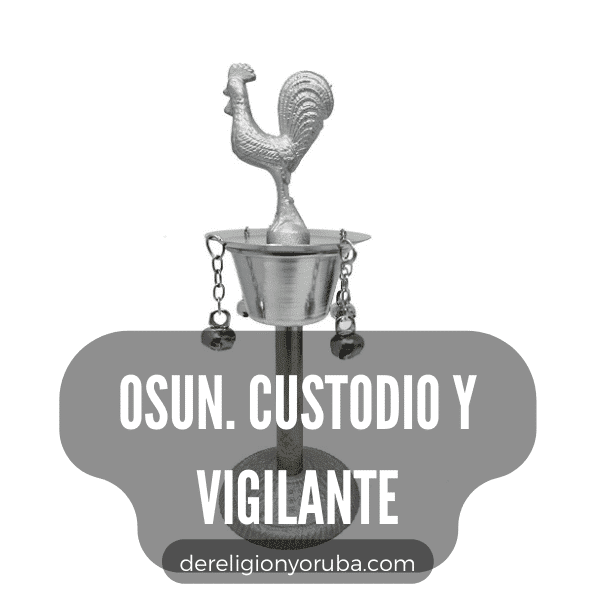
Note: Osun has children. When a person is a child of Osun, he receives the name Onijumo Naki. Osun is dreadful to behold and works directly with Oddudua and with certain Oshas such as Orunmila, Yewá, Osain, and others. When Osun comes forth in an itá, whichever Osha it may be must have an Osun standing beside it; it is loaded by the babalawo who is the person’s godfather, and it carries the following ingredients and ceremonies: uneru, sixteen, ewereyeye, ekú, eyá, oñí (honey), efún, one ikordie, agbado, otí, moruro, jagüey, sunrise, tengue; a white cockerel is given to it and this prayer is recited:
Symbols of Osun
The lid: Represents the board of Ifá
The rooster: Represents vigilance, for the akuko crows at every hour of the day
The cup: Represents the earth, half of the terrestrial globe
The rod: Represents Eyiogbe
The four funnels:Represent the four columns that hold up the world, the four cardinal points.
Characteristics of Osun
An orisha who acts as messenger of Obatalá, Olofi and Orula. They lean upon him to obtain their powers of divination and of real, transcendent knowledge. He is also the watchman over the heads of the faithful. He has no necklace and no hand of cowries. He is represented as a metal cup upon a heavy-based pedestal, with a rooster set on a perpendicular axis fixed into a covered vessel that contains the magical load, crowned with the figure of an animal, which may be a rooster or a dog.
Characteristics of the omo Osun
Similar to the omo Obatalá, but more subdued — not as haughty as they are; on the contrary, manageable and humble.
Attributes
- Symbol: Metal cup
- Color: He represents all the colors of the FIFÍ OCÁN in the initiation ceremony, because Ozun means color or paint. Red, blue, yellow and white.
- Herbs: The same as those of all the Warriors
- Number: 8, 16, 24
- Days: Thursday
- Parents: Obatalá and Yemayá
- Ilé: the foundation is placed in a metal cup upon a pedestal or heavy base, with a rooster of lead or metal at the top, though it may also be a dove, a dog or a lizard. There is an Ozun of the babalawo, a standing Ozun, an Ozun of Oddúa that matches the height of its owner and bears a dove with outspread wings, and an Ozun of San Lázaro (with a dog). It carries no stone.
- Syncretism: Saint Dismas, Saint Manuel, Saint John the Baptist.
- Illnesses: When he falls, he announces death or misfortune for his owner.
Implements
He is represented by a silvery metal cup that may bear the figure of a small rooster at the top and holds a secret load inside. Its base is solid so that it stands upright. He possesses no attributes and carries neither hands of cowries nor a necklace. His color is white above all, yet he also represents every color, because Osun is also color itself: the painting made on the floor beneath the mortar in the seating of Osha is called Osun, and the one made on the head of the iyawó is called Osun Leri.
Animals he eats
Animals he eats: His specific animal is the white dove, but he eats everything that is offered to Elegguá, Oggún and Oshosi.
Offerings
He is offered Orí (cocoa butter), Ofún (cascarilla) and Otí (cane liquor). The animals immolated to him are chiefly doves (eyelé) and the same animals given to the Warriors, except rooster or chicken, which is his taboo, as he himself is an akuko (rooster). His ewe are the same as those of the other Warriors, and he may also take the ewe of Obatalá.
Herbs
- Basil: used to attract prosperity and abundance.
- Lemon verbena: used to attract love and peace.
- Sweet herb: used to attract good luck and prosperity.
- Mint: used to attract luck and protection.
- Rue: used for protection and to drive away envy and evil spirits.
There is a yard Osun devoted to the eggun of the great awós
There, these great awós are given food. This Osun carries no load and has no base. Its lower end is a sharp, pointed tip meant for planting Osun in the earth; when he is to eat, it is wedged upright with stones. It is a metal rod with an upper plate of the same metal, from which hang sixteen little bells. When feeding eggun, the awó paints the signs of eggun and of the deceased awós — or of the deceased awó, as the case may be. These oddun are prayed over, the call is made with the suyeres of eggun, and then the animals are given. This Osun is called Akaulele Eggun, and every awó may have one. The Arará call Osun Acen. In the odu Otura Roso, Osun eats white rooster: Osun is stood in the center of the house and its eyegbale is given to the four pillars of the house. In the odu Iwori Bogbe, Osun eats hen, and in Ogbe Ate, Osun eats white turkey, to save a person from an illness. The Osun that keeps being prepared for San Lázaro crowned with a little dog is nonsense: given that Osun detests dogs, how could there be an Osun crowned with his worst enemy?
Patakí of Osun
Of course — here is another patakí of Osun from the Yoruba religion:
Legend tells that in a certain town there lived a woman named Oyá, who was in love with Shangó, the mighty king of lightning and fire. Oyá did everything in her power to win Shangó’s love, but he did not return her feelings. In despair, Oyá turned to Osun for help. Osun gave her a magic potion to make Shangó fall in love, but warned her that she must not use it to harm anyone. Oyá paid no heed, however, and used the potion to force Shangó to fall in love with her.
But the love spell had unforeseen effects: instead of falling in love with Oyá, Shangó fell in love with Osun. When Oyá realized she had lost Shangó, she flew into a rage and tried to harm Osun. Yet Osun used her magic to protect herself and Shangó, and in the end managed to calm Oyá.
This patakí illustrates Osun’s ability to protect herself and those who venerate her, as well as the importance of wielding magic with wisdom and care. It also shows that love cannot be forced or manipulated, and that the consequences of trying to do so can be unpredictable and potentially dangerous.
Patakí of the mirror of Osun
Once there was a king who was ill and could not be cured. One day, a diviner advised him to seek the help of Ozun, who could heal him. The king built an altar for Ozun and offered him a mirror, one of his attributes. Ozun was drawn to the mirror and decided to help the king. Ozun healed the king and left him the mirror as a token of his gratitude.