Eshu
3.232 words 15 min read
The history of Eshu
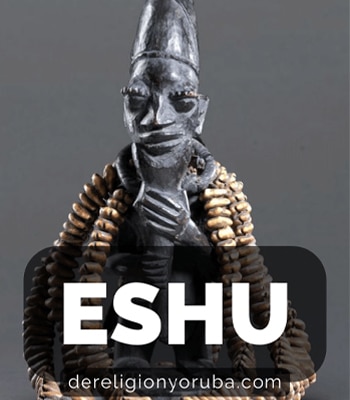
The history of Eshu goes back to the creation of the world in Yoruba mythology. It is said that Eshu was created by Olodumare, the supreme creator, to assist in the creation of the universe. Ever since, Eshu has been seen as an intermediary between the gods and human beings.
This deity was the first to arrive on earth, when everything was still darkness, which is why he is known as an orisha of darkness — malevolent, even compared at times to the figure Christianity calls the devil. Perhaps that comparison is what led some of those who deliver Eshu to tell their godchildren that what they were receiving was Elegguá or Eshu Elegguá, which is entirely false. The fact that he was the first to inhabit this world, and that he receives the same priority attention given to Elegguá, also feeds the confusion between the two deities. Eshu is an orisha of the group of the Orisha Oddé, commonly known as The Warriors.
He rules over the manifestations of the malevolent. For the benevolent to manifest, evil must be taken into account and precautions taken to evade it. He is the one forever playing tricks, deceiving both orishas and men in the various legends or patakíes. His meaning is the misfortunes that befall our lives when we are out of tune, out of balance, with what surrounds us. Eshu is the exclusive province of the babalawos, who load and deliver him; he does not go to anyone’s head, and therefore is never seated in consecration. According to Ifá he has 201 paths. There are even those who say that Eshu is not an orisha at all, since he is no one’s guardian angel and cannot be crowned, whereas Elegguá is.
For years, confusion has grown among practitioners of the Afro-Cuban Rule of Osha (Regla de Osha) between Eshu and Eleguá. Some, quite mistakenly, even call him Eshu-Eleguá as if he were a single deity being addressed by first name and surname — when in truth Eshu is one and Elegguá is another. They share more similarities than differences, yet the differences that do exist are sharply drawn, making it perfectly clear that each is a deity with an identity of his own, and therefore distinct from the other. We have already written about Elegguá; now it is Eshu’s turn…
It is not only that he was the first to inhabit the earth: for every orisha who came down to this world, an Eshu accompanied him; for every odu that descended, an Eshu came along as well — but to put obstacles and setbacks in the way, not to help or move things forward. For every Elegguá that exists there is an Eshu who serves as his counterweight, something like yin and yang. Eleguá as the positive side and Eshu as the negative: to Eleguá, who opens and closes the roads, offerings are placed to please him and receive what we ask of him, while Eshu is bribed so that he causes no trouble. There is a vast difference between giving an offering to flatter and handing over a bribe to keep away a troublesome, bothersome being.
So intricate is this deity that even making requests of him calls for caution — one must know how to ask, because instead of receiving what you request, he could turn everything against you… I would say that what one asks of him is simply that he keep his distance; it is that plain. Eshu is attended in order to keep him away. This is why the children of Elegguá, when they are to be made in the religion, must first fulfill several ceremonies whose purpose is to drive Eshu off so that he causes no setbacks on the day of the kari osha. The outing the iyawó omó Elegguá makes before entering the room of the saint — where there must be sweets, tobacco and rum — exists to drive from the life of Elegguá’s child the negativity of Eshu, who forever pursues him.
Eshu is loaded, as I mentioned earlier, but into a figure made of clay or cement, and the load varies according to the path of Eshu: building an Eshu Laroye, for instance, calls for different ingredients than an Eshu Afrá… The opposite happens with Elegguá, whose path is only discovered in itá after he has been born. Even so, just as there is an Eshu Laroye there is an Elegguá Laroye; for an Eshu Afrá there is an Elegguá Afrá; for an Eshu Alawana there is an Eleguá Alawana, and so on — which is what I have already explained: for every Elegguá there exists an Eshu who is his opposite face.
The role of Eshu in Yoruba culture
When a home is protected, the presence of Elegua is felt; when troubles arise there, it is because Eshu has entered. Westerners confused Eshu with the devil, but that is not so — if anything, he might be likened to the devil who tempted Jesus, and in nothing else, since his aim is to bring about chaos so that measures are taken to restore balance. In the Yoruba religion, Eshu is considered the first differentiated particle of life created by Olorun. The word Esu means «sphere,» and represents infinity, permanent movement.
Eshu is the messenger of the orishas; he is the intermediary between men and the orishas. He is the permanent line of communication between Aiyé (sometimes poorly translated as the world we live in) and Orun (the beyond, dwelling place of the orishas, sometimes poorly translated as heaven). Eshu Alawana, or Alaguana, is everywhere.
He lives alone in the dark, inhospitable reaches of the wilderness or the savanna. He is the chief of the eggun (the dead), with whom he keeps a great deal of dealings. He represents despair and misfortune. Eshu Alawana is the smallest of the Elegguá and often accompanies Oggún. He is considered the owner of every kind of chain, as well as of the guava-wood hook, of a cedar doll that lives and eats with him, and of the Arik Bambaya. He is a great sorcerer, with the power to free people from prison, and he is invoked with the guava-wood hook. He has his own Osain, prepared in a bull’s horn, and he has his own sopera (lidded tureen). For Eshu Alawana to work, he is placed on the floor atop the shell of a jicotea turtle. Among his tools are an Ariku Bambaya, chains, a guava-wood hook, his cedar doll and his turtle shell.
Who delivers Eshu?
In the days before Ifá had yet reached Cuba, Eshu was delivered by the santero. When Ifá arrived in Cuba, the babalawos took full authority over loading and delivering Eshu, while Elegguá remained the province of the olorisha or santero. This is because Ifá builds and Osha gives birth: the babalawo constructs Eshu using various materials and ingredients, while the santero births an otá of Elegguá from his own. Elegguá is born from the Elegguá the santero already has, whereas Eshu is constructed by the babalawo from the materials he gathers. Elegguá has his diloggún, his cowries, and goes to itá — in fact, it is with Elegguá’s cowries that the santero consults… Eshu has no cowries and does not go to itá… Elegguá is founded upon a stone (otá), generally dark and meant to come from the sea, which must pass through a ceremony performed by santeros in order to become an Elegguá.
Characteristics of Eshu
- Eshu is an orisha of the Yoruba religion who represents duality and ambivalence. While it is true that Eshu can bring misfortune, he is also regarded as an impartial judge who rewards or punishes according to each person’s actions.
- Eshu is credited with the power to control roads and crossroads, in the physical world as well as the spiritual one. He is seen as a mediator between human beings and the gods.
- Eshu has the ability to divert bad luck and misfortune toward those who deserve it, acting as a kind of karmic equalizer.
- If he is treated with respect and properly honored, Eshu can provide protection and guidance in everyday life.
- He is considered the guardian of morality and ethical values, which is why he is often consulted before making important decisions, to make sure one is acting according to the right principles.
- Eshu is also associated with mischief and trickery, since he is believed to test people’s honesty and integrity. He can expose lies and deceptions, and punish those who act unjustly.
- It is common to offer Eshu food and drink, such as rum or aguardiente, to maintain a good relationship with him and secure his favor.
- Although he is associated with negative aspects, Eshu is not inherently evil. His role is that of a fair and balanced judge who seeks to maintain order and justice in the universe.
How to attend Eshu
Eshu should not be given corojo — he does not like it. Both go in a clay dish, on the floor near the door of the house where they are kept, and they are offered the same things, but separately: what belongs to Elegguá is Elegguá’s and what belongs to Eshu is Eshu’s, and they will only share offerings or animals if — and only if — both accept them… If an ebbó is asked for by Elegguá and it is carried out with Eshu, the ebbó is not being fulfilled, because it is not being performed with the deity who asked for it, and vice versa. Every practitioner should have both Elegguá and Eshu: one to keep on our side, and the other to keep at the margin by negotiating with him. The pair Elegua – Eshu represents the constant bond between the positive and the negative, because every change demands a crisis, and there is no stillness without unrest.
How to honor Eshu
To honor Eshu, sacrifices and offerings are made to him. The offerings include foods such as corn, fruit and meat. He is also offered alcoholic drinks such as rum and aguardiente. Beyond offerings, Eshu is also honored through music and dance. Music and dance are believed to be a way of communicating with Eshu and winning his favor.
Animals he eats
Goats, roosters or chickens, chicks, jutías, and black or red mice are immolated to him.
Prayers
«Eshu, mo juba o! Baba mi Elegbara, mo juba o! Ajeje, Eshu, mo juba o! Alaaru l’eru, Eshu, mo juba o! Odara, Eshu, mo juba o! Omo awo, Eshu, mo juba o! Omo aiku, Eshu, mo juba o! Omo elere, Eshu, mo juba o! Omo esin, Eshu, mo juba o! Omo araye, Eshu, mo juba o! Omo oun ara mi dun Eshu, mo juba o!»
An approximate translation would be:
«Eshu, I adore you! My father Elegbara, I adore you! Ajeje, Eshu, I adore you! Keeper of all secrets, Eshu, I adore you! The one who is good, Eshu, I adore you! Son of the awó, Eshu, I adore you! Son of death, Eshu, I adore you! Son of prosperity, Eshu, I adore you! Son of the horse, Eshu, I adore you! Son of the inhabitants of the earth, Eshu, I adore you! Son of the one who makes me happy, Eshu, I adore you!»
Paths of Eshu
- Eshu Ayeru: Messenger of Ifá and his Guardian
- Eshu Abanulua Baba Ejiogbe: Works with Ifá
- Eshu Kinkeyo
- Eshu Laroye: The Revolutionary
- Eshu Male: The Elewa that Olofín gave to Orunmila
- Eshu Arayeyi: Gatekeeper of Olofín
- Eshu Akekelebiyu: He is from the Mina land. Plays marbles and spinning tops, and smokes cigarettes
- Eshu Alanki: Brother of the previous one
- Eshu Suayu: Lives in the yaya tree. In front of the door
- Eshu Batieyo: Always prevails and achieves his aims.
- Eshu Ileloya: Lives in marketplaces
- Eshu Lalu: The one of the four roads
- Eshu Arailele: Street dog
- Eshu Agroi: 22 Arará cowries
- Eshu Awere: Lives on the hill
- Eshu Awanleke: He is adult and works with the dead
- Eshu Merilaye: Lives at the four roads. Has 4 mouths and 4 Oyua
- Eshu Eboribueno: The Holy Child of Atocha. He is a twin. Carries 2 blades, 1 face.
- Eshu Karará. He is covered with seashells.
- Eshu Odemás He is of the wilderness.
- Eshu Jano He is made of cedar. Wears a yarey-palm hat and carries a yamao-wood hook in his left hand. Eats facing forward and backward. Dresses in black. His shirt is half black and half white.
- Eshu Akanadrede He is feminine, though some say he is Adodí.
- Eshu Bragada He is covered with mariwo.
- Baragargaluo: He is the messenger bird of Orunmila
- Eshu Owo: King of silver. He is mounted on a peso macho coin.
- Eshu Okubere: The one of life and death.
- Eshu Ewa: Lives in the savanna, near the wilderness of Oggún. His otá and his doll are of a very large size. He is an Elewa, very old and of the countryside, now very scarce.
- Eshu Barakeño: Lives in the nigbe. He hides among the underbrush and works his mischief from there. He is said to stand 3 inches tall. He carries Omo Titun.
- Eshu Oggunilebe: Causes accidents.
- Eshu Baraiye: Walks alongside Shangó
- Eshu Esherike: Walks with Osain
- Eshu Adawá: A flint otá. Carries no load.
- Eshu Bi: The one of the Maniwa
- Eshu Agegere: He is of the rubbish heap.
- Eshu Laye: This is the one of the cowrie shell.
- Eshu Layibere: He is the Iña of Elewa. He wears a mask.
- Eshu Alayiwi: He is a glutton.
- Eshu Awóbara
- Eshu Ekileyo
- Eshu Osukakugwo
- Eshu Okekeyebiye
- Eshue Ogemeye: Wears a crown made of a chain with 8 keys.
- Eshu Abalemke
- Eshu Aloma
- Eshu Baralanubo
- Eshu Mako: A tiny Elewa, made of Aye.
- Eshu Yelu
- Eshu Iyelu
- Eshu Ashikuelu: Lives in the marketplace.
- Eshu Aloba: Lives on the hill.
- Eshu Akere: Lives in the savanna.
- Eshu Alaleilu: Very old, wears a Chinese beard.
- Eshu Afradi Arará. An empty pot, prepared only when he is going to eat.
- Eshu Mawanilele Orun: An Eshu who lives at the shore of Okun.
- Eshu Obakekere: Wears a crown of goat hide and 21 cowries.
- Eshu Baraña: He is a drummer.
- Eshu Oniburu: Accompanies Orishaoko
- Eshu Arufín: The one who sacrifices.
- Eshu Aruda: The one who creates.
- Eshu Abelekuñe: Walks with Alawana
- Eshu Kotere
- Eshu Arerebioke: Lives on the hill, alongside Oggún.
- Eshu Agogo: Presides over the changing of the hour.
- Eshu Eluesama: He is malignant. Lives beneath the sugarloaf.
- Eshu Bede: Guardian of Oggún.
- Eshu Lareke: Lives on the hill. Dresses in blue.
- Eshu Abasinlaye Aye: Accompanies Oduduwa.
- Eshu Ebaralaketu: Accompanies Shangó.
- Eshu Laluekirioke: Lives in Aragba.
- Eshu Barabó
- Eshu Alufama: Curujey is placed on him.
- Eshu Nikiniki: He is the mayito bird.
- Eshu Doko: Lives in a basket. Deer hide is placed on him.
- Eshu Lamota
- Eshu Ibanla He is covered with a jícara (gourd bowl).
- Eshu Oroliú: Lives in Olokun.
- Eshu Obayila
- Eshu Agbebermoloki: This Eshu is the one who presides over sexual erection. He is indigent. When he descends at the batá drummings, he is known to expose himself and masturbate.
- Eshu Okuando: Lives in an earthenware jar. At the riverbank.
- Eshu Alimu: He is Arará. Works with Oyá.
- Eshu Abarikoko: Carries a tube holding various secrets in his load. The tube is made of bamboo.
- Eshu Kakosa He has two faces. He likes to be cleansed with pork fat.
- Eshu Lodo
- Eshu Arinika: He is from the Yobu land. A cedar doll.
- Eshu koima Koima
- Eshu Aletan: He is covered with white wood. He is very refined.
- Eshu Yokunyelode: Eats atop a pumpkin.
- Eshu Kenene: He is Arará.
- Eshu Ayontolu
- Eshu Nanko: Carries 9 Oru in his load.
- Eshu Añegui Olokún: He is the reef that lies beneath the water.
- Eshu Aletan
- Eshu Obanivana: He is the king of the dead.
- Eshu Lamulanubata Drummer and shoemaker. He is given 7 shoes.
- Eshu Lasho: Carries 9 Oru in his load.
- Eshu Unyolo: This Elewa shouts a great deal.
- Eshu Oroigi: Always accompanies Orun.
- Eshu Unibarakoñe: Lives beside the mamoncillo tree
- Eshu Awalabaca: Came down with the Star of the Ceiba.
- Eshu Wonde: He is truth and lies.
- Eshu Atulu: He is a majá snake.
Differences between Eshu and Elegguá
- First: Elegguá is a deity, a divinity, whereas Eshu is an entity.
- Second: Eshu and Elegguá belong to different lands and cults. We must be clear that the field of the oloshas (santeras and santeros) is one thing, and that of the Awo of Orúnmila and the babalawos is another. Eshu belongs to the land of Ifá; Elegguá belongs to the land of the oloshas — or, as we call it here in the Americas, the land of Osha.
- Third: Elegguá is sought out and then consecrated, whereas Eshu must be sought out, fashioned, loaded and then consecrated, which is the work carried out by the awós and babalawos.
- Fourth: Elegguá is an orisha or Osha (setting aside the distinction we draw here in the Americas between the deities, as opposed to how they are named in Africa) who can «go» to the head — that is, he is among the deities that permit the ceremony of seating known by any of these three names: Yoko-Osha, Kari-Osha or Sodorisha. Eshu, by contrast, being an entity, cannot be seated or «carried» to anyone’s head.
- Fifth: Elegguá «speaks» through the Diloggún, whereas Eshu does not possess that faculty. A rock that may serve to consecrate an Elegguá
- Sixth: Elegguá works as messenger of the Yoruba divinities (orishas); Eshu is the watchman over the fulfillment of the destiny each of us chose here on earth.
- Seventh: Eshu is associated with the concepts of light and darkness; Elegguá is tied to the notions of life and death.
- Eighth: Eshu is fashioned through a loaded Agboran, a loaded cowrie shell, a loaded figure of moldable material, a loaded pot that is then sealed, a loaded and sealed staff, and so on; Elegguá, by contrast, consists of a consecrated stone or rock and carries no load.
- Ninth: Within the theological sphere, Eshu is regarded as ENERGY, while Elegguá is defined as MATTER.
Syncretism
Syncretism is a practice common to many religions, and it refers to the merging of beliefs or deities from different traditions. In the Yoruba religion, Eshu has been syncretized with several Catholic saints as a result of colonialism and evangelization.
Some of the Catholic saints with whom Eshu has been syncretized are:
- Saint Anthony of Padua (Eshu Elegbara)
- Saint John the Baptist (Eshu Alaketu)
- Saint Jerome (Eshu Alawana)
- Saint Francis of Assisi (Eshu Laroye)
- Saint Peter (Eshu Onile)
- Saint Michael the Archangel (Eshu Odara)
It is important to bear in mind that these are only a few examples of syncretism, and the associations may vary by region and tradition. It should also be stressed that syncretism does not mean the deities are identical or interchangeable, but rather that they are joined in a complex symbolic relationship.
Conclusion
Eshu is one of the most important deities of the Yoruba religion. He is known as the divine messenger and the guardian of the roads. His history and mythology are fascinating, and his role in Yoruba culture is essential. By honoring and respecting Eshu, followers of the Yoruba religion can gain his protection and blessings in their daily lives.