Olokun
3.018 words 14 min read
Who is Olokun?
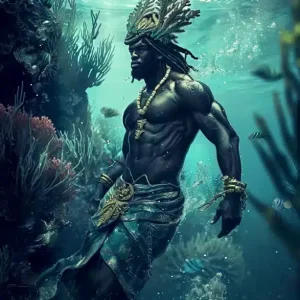
Olokun is a major orisha in the Yoruba religion of West Africa. Their principal role is that of guardian of the deep sea, ruling the tides, the storms and the waves of the ocean. In the Yoruba tradition Olokun is considered extraordinarily powerful, and is both feared and revered. It is believed that only the most experienced and powerful priests are able to invoke them. Olokun is associated with wealth, prosperity and abundance, being regarded as the owner of the riches that lie on the ocean floor, such as pearls and sunken treasure.
According to Yoruba tradition, Olokun is androgynous, bearing both masculine and feminine traits. So great is their power that they are represented with a mask, being considered too mighty for human beings to look upon directly. Beyond their role as guardian of the sea, Olokun is believed to hold the power to heal illness and to protect their followers from the dangers of the ocean. Devotees of Olokun often wear amulets and talismans bearing their image for protection. In the Afro-Cuban religion of Santería, Olokun is likewise an important orisha, associated with the color dark blue and with a seashell worn upon the head.
Olokun is a mysterious and powerful deity, embodying the terrifying and unknown face of the sea. They also stand for the immensity and majesty of the ocean. The mysteries and riches of the sea are attributed to them. Olokun is considered the Orisha of the babalawos and is worshipped in different ways across the different branches of the religion. It is said that Olokun speaks through Yemayá, the first avatar to reach the earth. It is also believed that Olokun dwells in a palatial cave surrounded by precious stones, its walls covered in ivory. Their principal color is black, and they are also associated with blue.
Devotees of Olokun perform genuflections early in the morning, and the rituals may last until nightfall. In the past, human sacrifices were carried out in Olokun’s honor: the victims were dressed in sumptuous garments and showered with gifts. They were also paraded through the town and promised that in their next life they would return as kings.
Olokun is symbolized by the seven seas that surround the world, each of which corresponds to an original aspect of Yemayá bearing names such as Ocute, Azabba, Mallelogun, Asesú, Oquero, Oroó and Ibu-Agana. These names represent the different aspects of Yemayá in relation to Olokun.
The myth of Olokun
According to the legend, Olokun ruled the depths of the ocean with power and majesty, and their kingdom was filled with sea creatures and hidden treasure. But one day a band of greedy humans discovered that kingdom and began to plunder it, stealing its treasures and killing its creatures.
Olokun, enraged by the invasion of their realm, decided to take drastic action. They summoned their armies of sea creatures and launched a war against the human invaders. The humans, however, proved too strong, and Olokun was defeated.
The humans, wanting to make certain that Olokun would never trouble them again, bound them in chains and cast them to the bottom of the sea. There, it is said, Olokun remains chained to this day, ruling their kingdom from the darkness and solitude of the depths.
The story of Olokun’s chain carries several layers of deep symbolic meaning. First, it is said to represent the struggle between humanity and nature. Olokun stands for the strength and majesty of the ocean, while the humans stand for the destructive power of greed and arrogance. Olokun’s chain is a reminder that nature will always prevail over humanity, and that we cannot go on plundering and destroying our planet without consequence.
Beyond that, Olokun’s chain also represents the inner struggle each of us wages against our own inner demons. Just as Olokun was chained by their own rage and desire for revenge, so too can we be chained by our destructive emotions. The story of Olokun is a reminder that we must learn to master our emotions and find peace within ourselves if we wish to avoid being shackled by our own weaknesses.
In short, the story of Olokun’s chain is a powerful metaphor for the struggle between humanity and nature, as well as for the inner battle each of us must face in our own life. Through the story of Olokun we can learn important lessons about the need to respect nature and to find inner peace.
The worship of Olokun
The worship of Olokun is widespread in the Yoruba religion. In Nigeria there are many temples devoted to the veneration of Olokun. Olokun’s faithful gather in these temples to present offerings and prayers. It is believed that the worship of Olokun can bring good luck, wealth and prosperity.
Olokun in popular culture
Olokun is a prominent figure in the popular culture of Nigeria and other West African countries. Their image is often depicted in works of art and craftwork. They are also mentioned in many songs and poems.
In short, Olokun is one of the most important deities of the Yoruba religion. She is believed to be the owner of the oceans and the deep waters, able to grant wealth and abundance to those who worship her. The worship of Olokun is widespread in Nigeria and other West African countries. Her image is often depicted in works of art and craftwork, and she is mentioned in many songs and poems.
Characteristics and attributes
- Symbol: A mermaid
- Number: 7
- Animals received: Generally aquatic ones. White roosters, deer, chickens, pigeons, guinea hen, pig, duck, ram, turtle and goose.
- Color: Blue and black
- Parents: Emerged from the body of Yemojá. The word Olokum in the Yoruba language
- Means: Oló (Owner) and Okún (sea)
- Greeting: When naming her, one touches the floor with the fingertips three times and asks for her blessing: Maferefún, Olokum
- Sopera: The sopera (lidded vessel) goes in an earthenware jar placed inside another jar, with a round black stone accompanied by another 7 black stones, 21 shells, the tools and the hands of cowries — usually 1 or 2 depending on the house of santo — which go loose inside the jar, not inside the additional jar.
Herbs
- Copalillo de monte
- Guama
- Hedionda
- Ratón de oro
- Rosemary
- Coralillo
- Hierba fina
- Cerrojo
- Culantro
- Anón
- Alambrillo, willow and paragüita.
Paths of Olokun
Olokun also has a set of paths associated with different aspects of their personality and powers.
- The first path of Olokun is known as Olokun Alagemo. This path is associated with wealth and prosperity, and it is said that those who honor Olokun Alagemo may receive their blessing in the form of financial success and security. In Yoruba culture, devotees of Olokun often perform rituals of offerings and sacrifices to make sure they remain on good terms with the Orisha and can receive their blessing.
- The second path of Olokun is known as Olokun Eleke. This path is associated with beauty and harmony, and it is said that those who honor Olokun Eleke may receive their blessing in the form of love and friendship. Devotees of Olokun Eleke often wear necklaces and jewelry inspired by Olokun’s sacred colors, blue and dark green.
- The third path of Olokun is known as Olokun Omoluri. This path is associated with healing and renewal, and it is said that those who honor Olokun Omoluri may receive their blessing in the form of health and vitality. In Yoruba culture, devotees of Olokun Omoluri often perform rituals of healing and cleansing to purify body and mind.
- The fourth path of Olokun is known as Olokun Onire. This path is associated with wisdom and knowledge, and it is said that those who honor Olokun Onire may receive their blessing in the form of inspiration and vision. In Yoruba culture, devotees of Olokun Onire often practice rituals of meditation and contemplation to connect with Olokun’s wisdom and knowledge.
In short, the paths of Olokun represent different aspects of their personality and powers. Each path is associated with a specific blessing that may be received by those who honor Olokun and offer them their devotion. By exploring these paths we can learn more about the richness and depth of Yoruba culture, and find inspiration and blessing in Olokun’s energy.
How to attend to Olokun
Olokun is attended to in the same way as Yemayá: the same fruits and vegetables are offered, along with pulses and cane syrup. As with all the santos, however, this one must rest undisturbed in their place, and we must make sure the water never runs dry. Their otás and other tools should be kept clean. On very special occasions, a red melon (watermelon) cut into 9 pieces may be set before them; after nine days the pieces are taken to the sea. Whenever addimús are offered, their 2 candles are placed on a white plate.
Offerings
Olokun is fed on the open sea. According to some beliefs, feeding Olokun is a thing to be feared: of those who set out, one always dies. Since no one wants to be the one who dies, the voyage is forever postponed. Even so, the dockworkers of the port of Matanzas revived this tradition in 1944. They would bring ground corn cooked with garlic, onion and lard; balls of coconut sweets; ekó; cane syrup; black-eyed beans; balls of boiled ñame; pork, fried green plantains; bunches of watercress, ears of corn and malarrabia (a sweet made from small pieces of sweet potato cooked in cane syrup with cinnamon sticks and tender leaves of bitter orange).
The animals already sacrificed (ducks, pigeons and white guinea hens) are carried in a basket on a blue cloth together with finado and toasted corn, 7 ekó, 7 olelé, 7 ekrú, 21 bars of gofio and cane syrup, 7 coconuts; 7 bunches of watercress; 7 escaroles; birdseed; brown sugar, rock candy, salt and, when Olokum asked for it, a white ram; fruit and 7 five-cent coins.
The family of Olokum is made up of nine santos: seven Bellis, Olokum and Changó. The Bellis are the following:
- Ainá: Fire
- Olokun: the sole power over these things
- Caindé: Over any obstacle.
- Ideú: Will raise you up
- Olóri: Great head
- Itáguo: Path of the elders
- Oronía: Land of the elders, or it is in the earth
- Arabba: Turns the people
- Changó: Father of these Belli.
It is important to remember that the word Changó means trouble. If there were not many troubles in life, both good and bad, the inhabitants of this earth would be lost, not knowing where they are headed, whether they will reach their goals in life or whether they will succeed or not. For this reason, this immensely powerful santo has two hands of cowries that never speak. He is a body without a head on the earth, for his head lies hidden in the depths of the sea and only God knows where it is.
Olokun has drums unlike those of the other santos, made especially for her. In one of her rites, for example, five drums are used, in another three, and in another only one. This last drum is used for a secret work that even the most distinguished babalochas, iyalochas or babalawos never see and never will see, unless they are chosen and duly prepared to take part in that work. This drum is different from the others because the others are made of wood, while this one is an earthenware jar containing its secret, used to speak with Olokun, to pray to her and to invoke her spirit. This same jar is also used for the spiritual invocation of Oddúa when the need arises.
Prayer
Iba Olokun fe mi lo’re. Iba Olokun omo re wa se fun oyio. Olokun nu ni o si o ki e lu re ye toray. Bomo taafi. Bemi taafi. Olokun ni’ka le. Moyugba ashe
translation
I venerate the spirit of the vast ocean. I venerate the spirit of the ocean, who is beyond all understanding. Spirit of the ocean, I will venerate you as long as there is water in the sea. Let there be peace in the ocean. Let there be peace in my soul. To the spirit of the ocean, the ageless one, I give my respects. So may it be.
Patakí of Olokun
Orishaoko was strolling along the seashore one afternoon when he saw the face of a beautiful young woman peering out of the water. Fearing it might be a trick of the eye, he asked her name and who her father was.
–My name is Olokun and I am the daughter of Obatalá –she answered from the water.
That night the farmer could not sleep for thinking of the beautiful maiden, and at dawn he hurried off to ask for her hand in marriage. Obatalá listened and, with great patience, told him: «It is true that my daughter has a very beautiful face, but she also has a flaw. I will only give her to you in marriage if you promise never to throw her flaw in her face.» Orishaoko gladly accepted the condition, and on the wedding day, when they reached the house, he discovered that his wife’s body was misshapen — but by then there was no turning back.
Time passed, and while the farmer worked his fields, his wife sold the harvest at the market. One day Olokun came home without having managed to sell the goods, and Orishaoko, blinded by anger, argued on and on until, forgetting his promise, he threw her flaw in her face. Olokun withdrew to her home in the sea, and such was her fury that the waters began to flood the land. The days went by and Olokun’s anger only grew. The people had nowhere to take shelter, and Orishaoko, filled with shame, made his way to Obatalá’s palace to beg for mercy.
The father sent message after message to his enraged daughter, but her resentment was such that she forgot all obedience. Then Babá, seeing that his orders went unheeded, sent Yemayá Okute to the house of Ogún in search of the strongest chain ever seen. When he had it in his power, he charged Yemayá Ashabá with chaining her sister to the bottom of the sea. Since then, Olokun lives bound in the depths of the ocean, where not even the eye of man can reach. But when she remembers the outrage she suffered, her wrath is such that the lands are flooded by the sea once more.
Ceremony of receiving Olokun
In the traditional presentation, the ceremony begins at the sea. An earthenware jar, a smaller jar, animals and foods are brought along. Once the water, the silt, the 9 stones, the cowries and so on have been gathered, rooster, duck, pigeon and guinea hen are offered, along with ekru, eko, olele (9 sweet bars, candy, toasted corn, smoked fish, smoked ñeque, sugar loaf, coffee, 2 eggs, charcoal, flour, ñajú, pork with green-plantain cracklings, epó (palm oil), cane syrup and bee honey), and obí (coconut) is given to the sea. This same ceremony is performed at the house, though the secret is delivered at the sea. The stones, the cowrie, the seawater and the silt are essential to this (it is the silt that confers ashé upon the omiero).
The tools are not strictly necessary; in truth they are merely allegorical, but the ceremony at the sea is indispensable. With the omiero of Olokum the recipient is washed, and afterwards the animals are sacrificed. Later, a basket is placed in the middle of the room with a meter of blue cloth lining the bottom. The basket is surrounded by white plates set a meter apart from one another; on them go the foods already mentioned. All the santeros present, one after another, take up a handful of what the first plate holds with both hands, touch it to their forehead, kiss it and place it in the basket. And so on, plate by plate. The last things taken are the eggs, which are passed over the closed eyelids. The eggs do not go into the basket until every santero has been able to repeat the same operation. Afterwards, the sacrificed animals are placed in the basket, omilasa and coins are added, and everything is sprinkled with cascarilla. The four corners of the blue cloth are taken up, this bundle — called the «carga de Olokum» (the load of Olokum) — is knotted, and it is carried to the sea as an offering. This ceremony does not represent any kind of cleansing.
No one may eat of the animals sacrificed to Olokum, given their mysterious and deadly character. In older times, the babalawos presented Olokun only rarely and on very particular occasions, for it entails an unforeseeable physical disappearance. Olokum lives outside the canastillero. In their presence one must not shout, make a commotion or blaspheme, nor even look inside the jar when it is being refilled with water (the water is never changed unless a sacrifice is made).
With Olokum, insurmountable problems concerning health are resolved. This is an Orisha who has never gone to anyone’s head or shoulders. One sign of the mysterious and terrible character of Olokum is that they speak in the Diloggun through the number 16 — a sign no one knows, which has no ebbó, and where the counsel given is to throw water upward like rain, because it foretells all the osogbos of the Diloggun.
Olokum is a foundation of the babalawo, who in older times were the only ones to present it. There are those who do not perform the ceremony at the sea and instead place two hands of Diloggun cowries, one at the bottom of the jar and the other in the smaller jar, adding only a set of tools, seashells and stones. In addition, a ritual called «dancing the basket» is performed, in which, once the load of Olokum has been prepared, all the santeros take hold of the basket with one hand, swaying it as they sing. SAWADÉ LADÉ OLOKUM. SAWADÉ LADÉ OLOKUM