Orunmila
2.828 words 13 min read
Who is Orula?
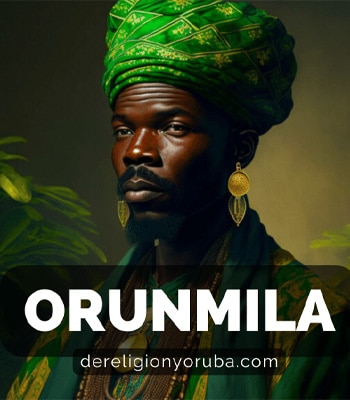
Orula, also known as Orunmila, is regarded as the orisha of wisdom, divination, and destiny. Below you will find what the Yoruba tradition teaches about Orula:
Orula is venerated as the orisha of divination and is known as the «orisha of destiny.» He is credited with knowledge of the paths of life and the power to reveal the future and hidden situations. He is considered the owner of the Board of Ifá, a divination system used by babalawos (priests of Ifá) to communicate with the orishas and receive guidance for making decisions and resolving problems.
Orula is associated with intelligence, intuition, and clairvoyance. He is believed to have the power to see beyond the visible and to provide counsel and solutions for overcoming life’s obstacles. Orula’s followers seek his guidance through the consultation of Ifá, a divination process in which the babalawo casts several objects and interprets the resulting patterns.
Orula, or Orunmilá, was born after Oggún committed the outrage against his own mother. Orula is the only orisha who holds the divinatory secrets of Ifá. He is regarded as the physician of souls par excellence. Owner of the four winds, which represent time and the four cardinal points. He imposes his will with great severity, and whoever fails to heed his counsel, whether human or orisha, risks becoming the victim of his punishments carried out through Eshu.
It was Shangó who, with Olofi’s authorization, gave Orula the até (divining board) and mastery of the secrets of divination. He is the revealer of the future and personifies wisdom and the possibility of influencing destiny. He is also the keeper of the secret of Ifá, the Supreme Oracle, and of the Ekuele, through which he communicates, even to intervene in adversity. He is not seated on anyone’s head, and he communicates only through his oracles, with the Ekuele and two hands of small coconuts.
Orula has no specific dances, since he does not mount his devotees, but dances are performed in his honor, and they have no distinctive features. Orula is the diviner par excellence; this is his true role within the religion. He has no other mission than to interpret the will and messages of the other orishas, and the only interpreters of Orula are the babalawos.
His power within the religion is so great that when he claims someone as his child or messenger, the chosen one must abandon the worship of any other orisha to devote himself to Orula. The first step is to receive the hand of Orula (Abo Faca), to which only the chosen have access.
Women have access to Orula through a similar ceremony (Ico Fa) in which they also receive the hand of Orula, but they cannot continue any further, as this is the highest level women can reach in relation to Ifá. Women initiated this way are known as apetebí; they are considered wives of the deity and partakers of some of his secrets. The ideal apetebí is a daughter of Oshún, and full access to all the secrets of Ifá belongs only to certain rigorously chosen men. No woman, and likewise no man of ambiguous sexuality, may become a babalawo. Within the Yoruba religion, only babalawos attend to Orula, though feasts and prayers may be offered to him.
Characteristics of Orula
- Symbol: Ékuele
- Number: 4
- Animals he eats: He is the orisha who eats least: only a chicken, and occasionally he will accept a goat. Black hen, pigeon, and deer.
- Herbs: Bastón de Orula (Hierba San Francisco or Palo San Francisco), malambre, pendejera, ginger, guanina, guasimito, Don Carlos, uvancillo, para mí, chinchita, myrtle, corn, honeysuckle, galán de noche, cañandonga (only in the eastern province), copey, corozo, purple aguinaldo, aceitunillo, small-leaf basil, almorejo, altea, arabo, red arabo, arará, acediana, bejuco fideo, colonia, astronomía, copey, coconut husk, yam, ojo de profeta, and paraíso.
- Color: Green and yellow
- Day: Sunday.
Sopera (lidded tureen): Ikofa (a small wooden vessel; in the case of an awo ni orunmila it will be large) - Tools: The Board of Ifá (até), the Ékuele; two hands of ikines, 2 oracles, a weight and a scale, an iddé, a poplar switch, an irofá (a deer horn used to write or tap on the board in various ceremonies), and an iruké (a fly whisk made of horsehair) used to sweep away bad influences. The board symbolizes the world.
- Necklaces: Of alternating yellow and green beads. The bracelets, or iddé, carry the same beads in the same arrangement. Both are received along with the foundations of the orisha in the consecration ceremony of this deity, which lasts three days in the cases of
Mano de Orula (Hand of Orula) and Ikofa. - Parents: Obbatalá and Yemayá Yembó
- Greeting: Iború, Iboya Ibocheche
- Illnesses: Madness
- Feast day: October 4.
- A major orisha, he is represented as a mature, wise gentleman, a benefactor to those around him. He is the god of divination, the chief counselor and benefactor of humanity.
The attributes or tools of Orula (also known as Orunmila or Orula Ifá) are
-
Ikofá, or divination board: The main instrument Orula uses to perform divination and offer counsel to his followers.
-
Irukere: A horsehair whisk used to cleanse and purify a person’s aura during ceremonies.
-
Opón Ifá: A wooden tray used in Orula’s divination; on it are placed the various elements that represent the symbols of the Ifá divination system.
-
Ide Ifá: A sacred necklace worn as a protective amulet and as a sign of belonging to the religion of Ifá.
-
Okpele: A divining chain used to complement divination with the Ikofá.
-
Agogó: A small drum used to call the spirits and to accompany the songs and dances of the ceremonies.
-
Opa Orula: A sacred staff that represents the bond between Orula and his followers, used to invoke his presence during ceremonies.
-
Adimu: The food offerings presented to Orula as a sign of respect and gratitude. Among the most common adimus are akara (bean fritters), eko (corn porridge), obi (kola nut), owó (money), and various fruits and foods.
These attributes and tools are of great importance in the Yoruba religion, for they are regarded as the means through which Orula communicates with his followers and offers them counsel and protection.
How to attend to Orunmila
October 4 is the day of all babalawos. On this day it is your duty to visit the house of your godfather and of your Yubona, with or without the derecho (ritual fee), for the purpose of greeting Orula. The derecho in these cases consists of at least 2 candles, 2 coconuts, and anything else you consider appropriate. On this day, the first thing you must do is kneel before Orula, resting both hands on the mat, and ask him for everything good for yourself and for those present. Then you greet as follows: «Orumila Iburu, Orumila Iboya, Orumila Ibosheshe…» and kiss the ground. Next, you turn toward your godfather and say: «Oluo Iburu, Oluo Iboya, Oluo Ibosheshe…» and kiss the ground. If your Yubona is also present, you say: «Oyubona Iburu, Oyubona Iboya, Oyubona Ibosheshe…» and kiss the ground. And if more babalawos are present, you say: «Bogbo Iboru, Bogbo Iboya, Bogbo Ibosheshe…» and kiss the ground.
Regarding the care of your ABOFAKAN or IKOFANFUN OF ORUNMILA: You must sit with him once a week or every ten days, preferably on Sundays. To do this, lay out a mat covered with a white cloth where you will place Orula, saying the word «ARGO» (permission) as you move him to either side, along with two candles. Then rub corojo butter on the left hand and honey on the right — a little on each — rubbing the seeds and blowing over them while asking for all good things. To do this you must not be unclean: you must not have had sexual contact and must not be menstruating, for at least the previous 24 hours. You must also bathe beforehand.
This saint is offered fine sweets, whole roasted fish, flowers, and balls of gofio. Two candles are always lit. The offerings are taken to the river and placed outside the sopera, with a candle on either side.
Prayers to Orunmila
ORUNLA IRAN LOWO KUELÚ RE TITANCHANI NITON LE RI NA KI ORE EYENI OMO TIWÁ ILE NI TOBÍ NI GBOGBONI LAIYE ODIKIU AIKI BABA WA.
Translation
Orunmila, help me with your wisdom and your foresight so that I may see, as you see, what this child who has come to my house presents. You are great, wise, and powerful, and my protector.
Songs
ORUNMILA TALADÉ, BABA MOFORIBALE ORUNLA IBORÚ E ORUNLA DI BOYE DIBO SISE
Translation
Only heaven can bring about salvation; it belongs to the one who holds the crown. Father, I place my head upon the earth. Heaven saves; the sacrifice has been carried out.
The sacrifice offered is fitting; the sacrifice is acknowledged. This sacrifice opens the way, and the causes are complete.
History of Orunmila
Furious with his sons upon learning that Oggún had tried to fornicate with his own mother, Obatalá ordered all his male children killed. Shortly afterward Orula was born, and Babá, without a word, took him far from the house intending to kill him. Elegguá, who
saw him leave, disguised himself as a mouse and followed silently to see what Babá would do with Orula, hiding behind the grasses. Babá stopped and began digging a rather deep hole at the foot of a ceiba tree; he buried Orula up to the waist with his arms beneath the earth. Elegguá ran to tell his mother, and between the two of them they decided not to let Orula die; it would be Elegguá who brought him food every day. At the very moment Babá buried Orula, he lost his memory and forgot everything.
Not long after, Shangó was born, a very strong and beautiful child. Babá took pity on him and, not wishing to harm him, thought of Dadá, the eldest sister of his children, who could raise him — since she lived far away, he would not see the boy, would not live with him, and would not have to kill him. He took the child to Dadá, dressed all in red, and asked her to raise him, for he had grown fond of him. Several years passed, and one day Dadá wanted Shangó to meet his parents; she dressed him in red again and took him to Babá’s house. When Yembó
saw her son arrive she began to weep, and Babá also wept, with joy; he sat Shangó on his knees and began to play with him.
Shangó, who was a very sharp child, asked his father why his mother wept so much and seemed unhappy with his visit. Babá answered that it was not true that Yembó wept because of his presence, and that one day, calmly, he would tell him everything — for even he could not remember well all the things that had happened before the boy was born. Babá asked Dadá to bring him to visit every day. A couple of years passed, and every time Shangó came in, Yembó dissolved into tears. This upset him, for Shangó had a fierce temper even as a child; it also bothered him to see his brother Ozún constantly lying on the floor by the door, never getting up for anything.
That day he decided to ask his mother what had happened to them all, for they seemed mad: she forever wailing, his brother lying on the floor, his father remembering nothing from before he came into the world. Yembó answered that she could do nothing for Babá, nor could she tell him what was wrong in the family, but that the secret of it all lay with his brother Elegguá. As Shangó and Elegguá loved each other and got along well, he went to his brother to hear everything he knew about his birth and the affliction troubling their father. Elegguá said to Shangó: «Take the pulp of three güiros, three pieces of coconut, three parrot feathers, rainwater, and corojo butter; prepare it all beside a ceiba, leave it three days and three nights, and when you take it out, make a poultice with cascarilla. Since you are the only one Babá carries and allows near him, when he opens his mouth, place a little on his tongue, his temples, and his eyes.» Shangó followed Elegguá’s instructions to the letter, and soon after anointing Babá with all these things, Babá began to recount to Shangó what had happened, recalling as well passages of his own life that came marvelously back to his memory.
It is here that the song is born which says:
ACHE SHANGÓ GUE MOGUE GUE GUO ORUMILA BEGUAGUA
Which means: «As a child, Babá told Shangó his whole life.»
When Shangó heard all that had happened, he came to hate Oggún, who had been the cause of it all. When he finished his account, Babá lamented having harmed Orula, who was guilty of nothing, and declared, for all to hear, that he would perform a very severe penance for what he had done to Orula. Elegguá, seeing the chance to save his other brother, who was still alive, approached his father and said: «Babá, I do not think you will need to do penance. You have suffered enough with the loss of your memory, and my mother Yembó has wept enough.» «What are you saying?» asked Babá. «What do you know that could relieve my grief and your mother’s?» «Listen, Babá: one day, passing by a ceiba, I saw a man buried up to his waist. I took pity on him, and every day I bring him food. This man is a great diviner, and many people go to consult their problems with him at the foot of Iroko, but no one dares to dig him out of where he is buried, for fear his father will kill him.
Hearing your story, I have come to think that this man is your son Orula.» Babá set out for the place where, long before, he had buried Orula, but as his memory still failed him somewhat, he lost his way from time to time. Each time this happened, Elegguá appeared to him in different disguises and showed him the right path. At last he reached the place where Orula lay buried, and Orula, seeing his father, recognized him and said: «IBORU BABAMI,» and Babá replied: «IBOCHECHE ORUMILA IBORU APETEVI ORUMILA.» Babá pulled Orula out of the hole and asked him to forgive him and return home with him.
Orula embraced him and said he bore no grudge against his father, for he knew what had happened to his head; but he could not leave that place, since the ceiba gave him its sticks, and the cowries scattered around it, so that he might divine — and that was his livelihood. Babá told him not to worry; he went straight to the ceiba, gave it some coins he carried with him, and promised it would be sacred and respected if it allowed him to cut a piece of wood to make Orula a divining board. Iroko agreed, giving him one of its finest pieces, and with it, right there, Babá fashioned a round board, gathered sand from the foot of the ceiba, and handed it to Orula, saying: «You are a diviner, and you shall divine in my house with this board of Iroko; every good Olúo will have to consult with you before doing anything.»
Orula answered: «MAFEREFUN ELEGGUÁ, MAFEREFUN SHANGÓ, MAFEREFUN BABA
Patakí of Orunmila
On a market day, Orunmila was performing divination for his clients when Olokun, the god of the sea, appeared to request a reading. Orunmila refused to perform the consultation, explaining that he lacked the elements needed to carry out a proper divination concerning the sea, and that it would therefore be better for Olokun to seek another priest who specialized in such matters.
Olokun, offended by Orunmila’s refusal, decided to play a trick to demonstrate his power. That night, Olokun flooded the market and the houses around it, causing great destruction and economic loss.
The people of the town, desperate at the situation, turned to Orunmila for help. Seeing the gravity of what had happened, Orunmila performed a divination and discovered that the flood had been caused by Olokun, who had taken offense.
Orunmila then decided to perform an ebbó for Olokun and ask him to halt the flood. The ebbó consisted of an offering of various elements, including fish, cowries, corn, and kola nut. Olokun, moved by the offering and by Orunmila’s wisdom, stopped the flood, and the town was restored to its original state.
This patakí teaches the importance of humility and respect toward the gods and toward the wisdom of the Yoruba priests. It also shows Orunmila’s ability to resolve difficult situations through divination and ebbó.