Oshosi
1.582 words 8 min read
Who Is Oshosi? His History, Characteristics, Attributes, Offerings, Care, Prayers and Syncretism
General Characteristics of Oshosi
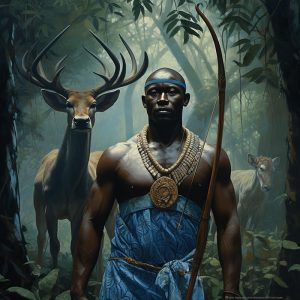
Oshosi is a major orisha, patron of those who have trouble with the law; he is a magician, diviner, warrior, hunter and fisherman. He symbolizes friendship, spiritual thirst, brotherhoods, love in the broad sense, the combined effort of many people, revolutions, collective organizations, humanism, altruism, the union of humankind, technological development and progress. He also stands for cooperation, mutual aid between peoples, solidarity, novelty, inventions, the conventional, freedom and societies.
Those under his protection tend to be very friendly, humanitarian, respectful of other people’s efforts, intellectual, highly ingenious, tolerant, individualistic, always on the side of progress, creative and independent. They can also be rebellious, scornful of traditional norms, delicate in their touch, disorganized, stubborn and inconstant. They stand out for their tolerance, loyalty, scientific mind and lack of foresight.
Animals
The animals that belong to him are the goat, the deer, the rooster, the young chicken, the dove, the jutía, the quail and every kind of hunted bird. Tools: his tools are three arrows, three dogs, a small mirror, a piece of deer antler, a fishhook, and a bow and arrow. Attributes: his attributes are all the instruments related to hunting and fishing, deer antlers and hunting trophies.
Animals He Eats
Red rooster, ram, goat, pig, agouti, guinea hen. He eats all birds, the hawk being his favorite.
Herbs
Espinilla, cercelera, esparrilla, fulminante (espanta policía), incienso guineo, jía blanca y brava, chincha, tobacco (green, dried and in flower), higuereta, basil, caña santa, pata de gallina, yerba de la sangre, mulberry, pegojo, huevo de gallo, dormidera, siempreviva, anamú, romerillo, rompesaragüey, purple basil, palo manajú, ebony, apazote, peonía, peregún, atiponlá, yerba fina, purslane, muralla, guava, avocado, almond, ceiba, álamo, piñón de botija, frescura, mastuerzo, carob, almácigo, pomegranate, galán de noche, plum, pendejera and maravilla.
Syncretism
Saint Hubert, Saint Norbert
Sopera
He goes in the iron pot (his sopera, or lidded vessel) together with Oggún. When received as a fundamento, he goes alone with all his attributes. He is always accompanied by the soperas of Elegguá and Oggún.
Attributes
Every instrument related to hunting and fishing, deer antlers and hunting trophies.
- Color: lilac, or blue with yellow
- Day: Monday, Tuesday, Wednesday and the 4th of every month
- Parents: Obatalá and Yemayá
- Greeting: see Prayers. The left leg is raised while the hands mime the shooting of an arrow, saying: OSHOSI ODDE MATA, which means «holy hunter».
- His children greet him lying face down with their arms held against their body.
- Symbol: bow and arrow
- Number: 3
Tools
- Three arrows (like the ones warriors used),
- 2 or 3 dogs
- A mirror
- A piece of deer antler
- A fishhook
- A bow and arrow
- Three long spears
- A trident in the shape of a large arrow.
Offerings
- Game animals: since Oshosi is the divine hunter, he may be offered symbolic game animals, such as birds or rabbits.
- Corn and legumes: Oshosi has a close relationship with agriculture and fertility. Offering corn and legumes, such as beans or chickpeas, is a way of honoring this connection and showing gratitude for the blessings of food and abundance.
- Aguardiente or rum: Oshosi is known for his fondness for spirits. Pouring a small amount of aguardiente or rum as an offering is a way of sharing and enjoying it with him during the ritual.
- Candles and large votives: lighting colored candles, such as green and blue, is a common way of honoring Oshosi. Large, thick votive candles may also be used to represent his power and presence.
Remember that when making offerings to Oshosi, it is important to do so with respect and devotion, following the practices and traditions of your specific spiritual path.
How to Attend to Oshosi
It is important to attend to Ochosi properly on Tuesdays. During the ritual he is offered honey. Aguardiente or rum is also blown over him as a sign of reverence and respect. Tobacco smoke is used to purify the space, and toasted corn, smoked fish and smoked jutía are sprinkled over Ochosi as an offering. These actions seek his help and favor in our needs and desires. Fresh fruit: Oshosi appreciates fruits such as bananas, mangoes, grapes and oranges. They can be placed on a plate or in a basket before his altar as a token of respect and devotion.
Elekes (the Necklaces)
Those not yet initiated receive a small chain strand made up of two threads of Prussian blue beads with an amber bead interspersed between them. They also carry amber beads, leopard fangs and cowries. Some use bright green matipó beads, while others prefer coral beads, which are the most common. Strands with alternating blue, Prussian blue and coral beads can also be found.
Characteristics of the Children of Oshosi
The followers of the primordial hunter are lively, quick, always alert, full of initiative, hospitable, and lovers of change and new ventures, although their nomadic streak can sometimes take a toll on their family. Oshosi is the major orisha who protects those in trouble with the law — the finest hunter, diviner, warrior, fisherman, magician, sorcerer and enchanter. Even so, Oloddumare only allows him to use his arts of sorcery for good.
Gunpowder is burned in his ceremonies, and he is closely linked to the mayomberos. Another of his duties is to hunt so that Olofi and Obatalá may eat. Ebbó (ritual cleansings and offerings) are performed with Oshosi to come through surgical operations well, since he has a close relationship with doctors in Ocha, together with Inle and Abbata.
Oshosi lives in the prisons and protects people who have trouble with the law. He and Obatalá carry out the Yoruba rite of justice, preferably in the open air and in the wilderness, where Oshosi lives, for he dislikes being confined. It is best to work with Oshosi in the morning, when he goes out to hunt.
It is a mistake to think that receiving him allows one to mock the law. Those who believe they can act with impunity under his protection forget that, just as Oshosi can free from prison someone who does not deserve it, he can also put behind bars someone who is guilty. Oshosi dresses like Elegguá and Oggún, for he is a warrior.
History of Oshosi
Oshosi is the finest hunter and his arrows never miss. Yet there was a time when he could not reach his prey because of the thickness of the forest. In despair, he went to Orula, who advised him to perform an ebbó. Although Oggún and Oshosi were enemies because of the discord Eshu had sown between them, Oggún had a problem much like Oshosi’s. No one could cut trails through the forest faster than he could, yet he never managed to kill his prey — it always escaped him. Oggún also went to see Orula and received instructions to perform an ebbó.
So the two rivals set about fulfilling their rituals. Without realizing it, Oshosi dropped his ebbó on top of Oggún, who was leaning against a tree trunk. They had a fierce argument, but Oshosi apologized, and they sat down to talk and share their troubles. As they spoke, a deer passed in the distance. Quick as lightning, Oshosi sprang up and shot an arrow that pierced its neck, leaving it dead. «You see,» sighed Oshosi, «I cannot get to it.» Then Oggún took his machete and, in no time at all, opened a trail to the deer. Delighted, they reached the animal and shared it. From that moment on they agreed that they needed each other and that apart they were nothing, so they made a pact in the house of Orula. That is why Oshosi the hunter always walks with Oggún, the owner of iron.
Prayers
OCHOSI OLUGA NO GBOGBO NA ODE ATI ORICHA CHECHE ODE MATA SI MI ATI GBOGBO OMO NILE FUNCI OKAN ONA ATI KUELURE OFA DURO GBOGBO BURUKU KIWA NITOSI NI ODUKE BABA MI.
Owner of all hunters and saint of justice, hunter, do not betray me nor any of your children on earth; give me a good path and with your arrow stop every evil that comes toward me. Thank you, my Father.
Oshosi
OCHOSI AGUOLA AGUILODA ALAMALEDA ALAMADALE ILE ODEMATA ONIBEBEONIBEBE ORICHA ACHÉ OCHOSI TOMA LO OCHOSI CHEMBERLI IROLO ODEMATE
CHOLONA E ODEMATA CHOLONA AYUBA.
Songs
KORO-KORO KOMODE MORÓ. LAYE-LAYE KOMODÉ KODÁ. OSHOSI OMÁ-OMÁ OSHOSI OMÓ OBATALA AWADÉ OMÓ LENIKI. AWADÉ OMOÓ MA FE WA AWADÉ OMÓ LENIKI AWADÉ OMÓ YA KU ARÁ KEYAKÚ ARÁ. OSHOSI AYILOODÁ MALAMALA DE OSHOSI BABÁ AYILOODA MALAMALA DE OMA OSHOSI ODE MATA OSHOSI BABÁ AYILOODÁ MALAMALA DE
Translation
Teach the tradition. Teach the hunter’s child the tradition. To hold the world, to hold the world, teach the hunter’s child to sing well. Oshosi knows — he knows. Oshosi is the son of the king of the white cloth. We seek the hunter, the powerful child whom we greet. We seek the hunter, the child we know has died. The families have had the pleasure of being friends of the departed. Oshosi, the one who stirs and drives away hunger, the one who arrives dizzy. Oshosi, the great one who drives away hunger, the one who arrives dizzy. You are Oshosi, the hunter; do not shoot at me. Oshosi, the one who stirs and drives away hunger, the one who arrives dizzy.