Oyá
2.993 words 14 min read
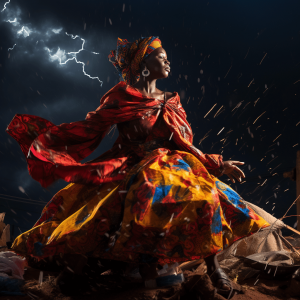
Oyá is regarded as a major orisha, a warrior and the owner of lightning flashes. She stirs up the strong winds and keeps the gate of the cemetery. She is the most warlike of the female orishas and is closely tied to death (Ikú). She is violent and impetuous. In hard situations she presents herself as a man and fights as fiercely as any of them. Whirlwinds and hurricanes belong to her. It is said that she was the wife of Changó, the god of thunder, and that she always rode at his side in his campaigns.
When she goes to war, she is accompanied by an army of spirits (egguns) and fights with lightning bolts and two swords. Oyá, or Yansá, is the orisha of the Niger River, born of Yemayá and one of the three wives of Changó. Iyá Mesam Orun means «Mother of the nine Oruns,» and she is another of the great orishas of this land. She is the sovereign of the winds, the storm, death, the whirlwind and the gates of the cemetery. She commands the egúns — that is, the malevolent spirits that cause physical and psychic disturbance in the people they subjugate.
She holds dominion over troublesome spirits. She carries the ebó (an offering or animal sacrifice made to an orisha) to the cross of the cemeteries. When she mounts her children, they dance with one hand on the waist and the other extended, fingers half open, swaying to mimic the winds and storms that shake the leaves of the coconut palms, and they call for her Iruke (a horse’s tail), which they often place upon her head.
Oyá and her winds help sustain the world after the waters of Oshún and Yemayá have given life and meaning to our existence. The winds of Oyá carry the pollen of different plants from one place in the universe to another. Oyá is also the very element we breathe, for she supplies the air with the right measure of oxygen to keep us alive and functioning.
Without air we would suffocate and perish. No form of life on this planet can survive without it, not even the fish. Plant life, above all the seaweed of the oceans, provides the oxygen that life in the sea depends on. As you can see, Oyá is present everywhere.
General characteristics of Oyá
- Symbol: iron machete
- Color: nine colors, all except black
- Number: 9
- Dress: her children wear wine red with an overskirt of mariwó and another, movable one made from kerchiefs in nine colors. They may also wear a dress of flowered cretonne instead of the wine red, and a nine-pointed crown adorned with parrot feathers.
- Day: Friday and Sunday
- Parents: Yemayá Yembó
- Salute: her children lay their bodies on the ground on one side, alternating the elbow and
the left and right side, and say: JEKUA JEI YANSÁ OYABI IKÚ (Oyá who gave birth, Oyá who punishes).
Animals she eats
She eats only fowl, preferably hens and guinea hens, preferably black ones. She eats no four-legged animal.
Herbs
Flor de cementerio, espanta muerto, cambia voz, llantén, vergonzosa, artemisa, bonita, varia, alcanfor, palo rayo, cabo de hacha, quiebra hacha, ciprés, revienta caballo, flamboyán, purple avocado, guasimilla, baría, mazorquilla, yuca, ciruela, palo coja, cabo de hacha, coralillo morado, eggplant, árbol bonito, caimito, caimitillo, papaya, geranium, pomegranate, guare júcaro, maravilla, mil flores, palo rompe hueso, coralia, avericuto, palo rayo, bejuco, curujey, croton, cherimoya, meloncillo, papos, pepino cimarrón, tamarind, verbena and ivy.
Sopera
The sopera (lidded tureen) of Oyá is of porcelain painted in nine colors, all except black, and nine stones are placed inside it. Upon the sopera rests the crown, from which nine pieces hang, and at times nine interlaced copper bracelets are added.
TOOLS
The crown of Oyá is made of copper and has nine points from which nine pieces hang, among them: hoe, pickaxe, Oshosi, lightning bolt, scythe, staff, rake, axe and digging stick, together with nine copper bangles. At times other elements are included as well, such as the mask, the scimitar (the sword of Oyá) and the curved blade (sickle), the bow and arrow, and the serpent, which is a symbol of war.
Attributes
The black iruké adorned with the same beads as her necklaces, the lightning flash, the cemetery and burials. She is also associated with a skirt made of nine hanging kerchiefs in the nine colors of the rainbow, and with ochre-colored fruits, above all the eggplant. Other elements include the airs, winds and storms, the reincarnation of the ancestors, the loss of memory, and the sound of the seeds in the dry pod of the flamboyán tree, which is used to call her.
Elekes
Elekes (the necklaces) of brown beads with black and white stripes, called Matipós pun-ó. There are also necklaces of lilac beads with yellow stripes. In some cases, necklaces of black and white beads are used, even in groups of nine.
Syncretism
The Virgin of Candelaria, and also Saint Teresa of Jesus
Offerings
White rice with eggplant, plátano indio (a small Cuban banana), and black-eyed pea fritters.
Illnesses associated with her
Those caused by electrical discharge and strong drafts of air. She takes advantage of whoever is sweating to strike them with a chill.
Characteristics of the children of Oyá Yansá
They are violent, powerful, authoritarian, and of a sensual, voluptuous temperament. They can be extremely faithful, though they are also much given to extramarital adventures. Even so, they are always very jealous.
Lightning, wind and storm are three of the domains of Oyá Yansa. She lives at the gate of the cemetery and holds power over the Eggún, the spirits of the dead. When she is calm she is a countrywoman — hardworking, affectionate, sweet and caring. But when she is furious and unrestrained she is terrible, for she carries the war attributes of Oggún and Shangó. When that happens she becomes false and deceitful. She fills with malice and, like the hurricane and the tornado, turns into a whirlwind of fury — all the more if what provokes her fury is jealousy.
Like gales and storms, Oyá tends to be violent and impetuous. She is the goddess of the Niger. The wooden carvings that represent her show a goddess with nine heads, an allusion to the nine mouths of the Niger. She is also the owner and goddess of the cemetery and its markets.
Oyá represents one of the five most important elements of human existence: the atmosphere, the air we breathe (Afefe). She is one of the first assistants (Feisita) of Olofi. When something happens, or when someone is born or dies, she is the first to know, and she informs the orisha at once by means of the Wind. Thus the wind (Alefí) is her messenger. For this reason, petitions for the health of the sick are addressed to Oyá.
Likewise, because Oyá is death itself in person, at ceremonies for the dead one of her daughters is asked to dance the drum.
Prayers
Oyá Yegbe, diosa guerrera y justa, ayúdanos a estar libres de los vientos del oeste, ahuyenta el viento de muerte desde la montaña y danos tus instrumentos de guerra, escúchanos con prontitud. Oyá mujer, escúchame pronto, escúchame diosa de los Eggún, recibe esta ofrenda. Oyá, reina y señora mía, lleva mi petición hasta nuestro señor Olofi, protégenos del mal y desvía las penas de nuestro camino. Gracias. Oyá.
OYÁ ALLEGUE ALLILODA OBINI LLAGUE AGUIDIMULE ABILICO OBINI CHACOTO BERCUAN TELE CUAREIOLLA OYÁ YUMUSEOSO AYUBA.
No precise translation of this Lucumí invocation is available; the wording is preserved here exactly as it was recorded.
Songs
AYILODÁ YA OKU O OLOMO DE KE EYÓ AYABA OYA DE ARIWÓ, OYA NSAN LORO SOKOTÓ OYA DE ARIWÓ O MESAN LORO SOKOTÓ
Translation
That which is braided for creation — mother, long life to you. The owner of the children has arrived: shouts of joy. We turn around to meet her. She who tears arrives with great noise and by tradition wears trousers. She who tears arrives with great noise; the number nine by tradition wears trousers.
Paths of Oyá
-
Oyá Yansa Bi Funko: This is the path of Oyá who can do anything and obtains whatever she desires. She is strict with her children, punishes her enemies with suffocation and terrifies them from behind. In this aspect she is the inseparable companion of Eggun and Iwin. She is very powerful and achieves everything she sets her mind to. She is also invoked to resolve matters concerning couples and extramarital relationships — for good or for ill. Her offerings are made at park fountains where sweethearts gather, or in the wild brush wherever a stream is found. She says: «fuego al hombre que te ha dejado, fuego, fuego, fuego» (fire upon the man who has left you — fire, fire, fire).
-
Oyá Dumí: This is the path of Oyá to whom Shangó gave his até, granting her clairvoyance and great magic for all eternity. For this reason her daughters on earth have a strong predisposition for the Rule of Osha (Regla de Osha). Oyá Dumí is very closely linked to Elegguá and Babalu Ayé. She knows the secrets of Ifá, and on this path the ebbo is usually performed in the consultation room in order to strengthen skill in the art of divination. She is born in the oddu Obbara Melli.
-
Oyá De: Oyá De is a warrior and a huntress; she works in the fields and woodlands near the rivers.
-
Oyá Bumí: Oyá Bumi is the one who lives in the deep pools of rivers and lagoons; she is the one who raises the whirlwinds over the water.
-
Oyá Bomi: Oyá Bomi is the one born in the waters; she works in the rivers and along the seashore.
-
Oyá Nira: Oyá Nira was queen in the city of Ira. She is associated with the swelling of rivers, with mud and with the rains. Her husband is Oggún Onirá, and both are warriors belonging to the lineage of the «Water Orishas.»
-
Oyá Igbalé: On this path, Oyá Igbale works in the cemeteries by night with the egguns, and also on the sacred mountain. She carries a whip, an irunké and a fan. It is a path of Ajalorun (the blizzard of the sky).
-
Oyá Niké: Oyá Niké is the one who works on the hills, mountains and stony places. She deals with the egguns and commands the winds from the summit. She carries an irunké, a leather fan and a drinking horn.
-
Oyá Tolá: Oyá Tolá is the one charged with bringing honor and riches. She is given gold bracelets, rings, jewels and the like.
-
Oyá Dira: Oyá Dira is a violent warrior who incites envy, jealousy and quarrels. She is the companion of Eshu Omo Pupa.
-
Oyá Funké: she holds power over the winds and storms, throws into upheaval every place she passes through, and receives her offerings in high places.
-
Oyá Iya Efon: she is the buffalo mother, a path of Ajalaiye, the blizzard of the earth, a path of great fierceness.
-
Oyá Afefere: she is the wind from every direction.
-
Oyá Yansá Mimú: she was stolen by Shangó from Oggún the warrior. She has a great disposition for combat and goes looking for fights. Her principal weapon is a double-edged sword in the shape of a lightning bolt. Oyá Mimú has nine aspects and speaks in the diloggun through Ellioco Metanla (2-14). She was born in Mina popo.
-
Oyá Obinídodo: she is a born warrior, an implacable champion of order and justice. She is charged with guiding the dead to the cemetery and leaves their souls in the hands of Babalú Ayé. This is the best-known path of Oyá in the Rules of Cuba. She remains inside the cemetery, and its side gate belongs to her. She was born in the city of Oyó.
-
Oyá Yansa Duma: she rules over the plains and the forests. She is associated with Oke and is a very good friend of Ossain. The horse belongs to her. She is said to be hermaphrodite. She was queen of Koso and has a sister named Yansá Ayao, who is a virgin and is not crowned.
-
Oyá Yansa Doco: she adorned the temple of Olofin, turning it into a celestial paradise with plants and greenery everywhere. Yansa Doco controls the force of the wind, tornadoes and storms.
-
Oyá Tombowa: she is the queen of the dance. She is greatly feared and respected by the eggun. She is always allied with Elegguá, together with her sister Dumi.
-
Oyá Ayawá: she is old and wise, with long experience in witchcraft and high magic. Yansa Ayawa speaks in the diloggun through Ojuani; everything she desires, she obtains. On this path Oyá is hermaphrodite.
-
Oyá Tapa: she is the wife of Oggún, from the territory of Oyó. Her daughters have the faces of witches, and she works for good and for ill alike. She was consecrated by Orunmila in the divinatory arts. She comes from Takua.
-
Oyá Tomboro: she is very old and came from the mountain of Ewe. She has great knowledge of the plants from which she prepares medicinal remedies, and she is associated with Ossain. She does everything with omieros and is deeply respected by the eggun. She speaks in the diloggun when Ojuani Melli Ellioko (6-6-2) appears. All her offerings are placed near animal skeletons on a mountain or among the trees of the forest. A jug of aguardiente (cane liquor) is set out for her; one does not drink from it, but rather raises a toast to her friend, Eshu Aroni.
-
Oyá Yansa Odó: On this path, Oyá Yansa Odo always keeps her face covered with what Babalú Ayé gave her. She is said to be the elder sister of Obba, and she burned her face saving Obba from a fire. She is a warrior and a very capable witch; since that incident she works only for ill. She is not allowed inside the house, but stays near it. She is a friend of the eggun.
-
Oyá Yansá Orirí: Oya Yansa Oriri is the most intelligent and skillful of the Rule of Osha. She is fiercely jealous over Shangó and will do whatever it takes to please him, at times to excess.
All her daughters become devotees of the cemeteries, for that is the place where they pray to her and where she takes her offerings; it is also there that their petitions are buried. She is born in the oddu Obbara. Her children are great leaders in business. She is found beside a Lota Mimu. She was also queen in Koso and has a sister, Ayaó, who is a virgin and is not seated in consecration.
Patakí of Oyá: Shangó discovers Oyá’s lightning
It is known that Oyá accompanied Shangó in all his battles, fighting at his side with two swords and destroying his enemies with her lightning. Oyá was married to Oggún, but she fell in love with Shangó and he carried her off, which set in motion the famous feud between Oggún and Shangó.
One day, during a festival, Shangó was arrested for his rowdiness and locked in a dungeon behind seven turns of the key. Shangó had left his mortar in Oyá’s house. Days went by, and since Shangó did not return, Oyá moved his mortar, looked, and saw that he was imprisoned. Then Oyá sang: «CENTELLA QUE BA BENÉ, YO SUMARELA SUBE, CENTELLA QUE BA BENÉ, YO SUBE ARRIBA PALO». She said no more than this, and the number seven formed in the sky. The lightning bolt broke the bars of the prison and Shangó escaped. Then he saw Oyá coming across the sky in a whirlwind, and she carried him off from the earth. Until that day, Shangó had not known that Oyá possessed lightning. From then on, he respected her.
Patakí of Oyá Yansá: the deception of Obbá Naní
Oyá was married to Oggún, but she fell in love with Changó and let herself be carried off by the god of thunder, which bred the enmity between the two orishas. It is said that one day, during a festival, Changó was arrested for his rowdiness and locked in a dungeon behind seven turns of the key. Seeing that her beloved did not return, Oyá glimpsed Changó in his cell. With a song, the powerful orisha stirred the winds, and from the sky came down a lightning bolt that broke the bars of the prison. Oyá appeared in the sky in the midst of a whirlwind and rescued Changó. From then on, Changó respected Oyá.
According to the legend, Oyá deceived Obba Nani, Changó’s other wife, leading her to cut off one of her own ears. Mamá Oyá Ferekún, the Virgin of Candelaria, is the owner of the Lightning Flash. She is the inseparable and faithful concubine of Changó; she follows him everywhere and fights at his side in every battle.
Oyá Obinidóddo is the right arm of Changó and always fights at his side with two swords. Oyá is also the «ill wind,» the whirlwind, the devastating waterspout or wind funnel. She was the wife of Oggún, from whom Changó took her in revenge. She is a crowned santa, boloya — a handsome woman. She can also be duplicitous, violent and cutting. She is the owner of the cemetery and lives at its gate or in its surroundings. She is always found together with Obba and Yewá. Together with Elegguá, Orula and Obatalá, she commands the four winds.
As you can see, Oyá is a fierce warrior who rides into war with Changó, shares thunderbolts and fire with him, and was at one time the wife of Oggún, with whom she also exchanges tools.